
On 15 April 2026, the Board of Directors of the Public Investment Fund (PIF), chaired by His Royal Highness Prince Mohammed bin Salman bin Abdulaziz Al Saud, Crown Prince, Prime Minister and Chairman of the Board, approved PIF’s 2026–2030 strategy. The new strategy represents the next phase of PIF’s long-term plan and a deliberate evolution from a period of rapid growth and capital deployment into one defined by value realization, investment efficiency, and deeper private-sector partnership. For businesses, investors, and professional advisors operating across the Kingdom and the wider region, the strategy sets out a clearer map of where PIF intends to concentrate capital, build national champions, and invite external participation over the next five years.
A strategy built on a strong five-year base
The 2026–2030 strategy builds directly on the achievements of PIF’s 2021–2025 cycle, during which the Fund materially repositioned itself as a driver of domestic economic transformation rather than simply a custodian of sovereign wealth. Over that period, PIF invested approximately SAR 750 billion (around USD 199 billion) in new domestic projects, representing roughly 70% of its total investments, and grew its assets under management from USD 150 billion in 2015 to more than USD 900 billion. The Fund also contributed more than USD 243 billion to real non-oil GDP between 2021 and 2024, equivalent to around 10% of Saudi Arabia’s total non-oil GDP in 2024 and delivered an annualized total shareholder return of more than 7% since 2017.
PIF now holds investment-grade credit ratings from each of the three major global rating agencies, including an Aa3 rating with a stable outlook from Moody’s and an A+ rating with a stable outlook from Fitch, making it one of a small number of sovereign wealth funds with that distinction. That financial and institutional foundation is important context for the new strategy: the question being addressed is no longer whether the Kingdom can mobilize capital at scale, but how that capital is converted into sustained, commercially credible value.
Three portfolios, one mandate
Under the 2026–2030 strategy, PIF’s investments are structured into three distinct portfolios, each with a defined strategic role. The Fund’s mandate itself remains unchanged: to drive the economic transformation of Saudi Arabia and to generate sustainable financial returns.
Vision Portfolio
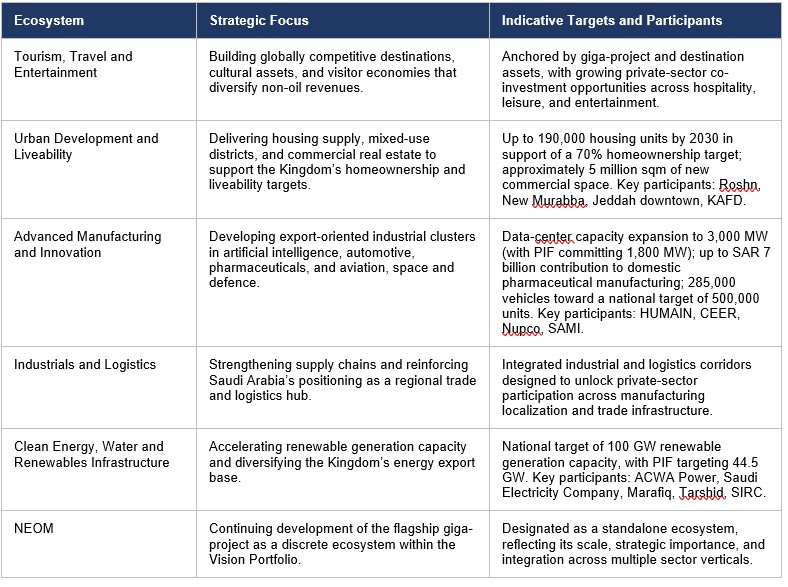
The Vision Portfolio is the engine of PIF’s domestic transformation agenda. It is designed to deepen integration across the Kingdom’s priority strategic sectors, maximize value across PIF portfolio companies, and sustain the growth of the local economy. Practically, the Vision Portfolio consolidates PIF’s existing 13 strategic sectors into six fully integrated economic ecosystems. It also creates new entry points for the domestic private sector to participate as investors, partners, and suppliers, while attracting international co-investors and operators.
Strategic Portfolio
The Strategic Portfolio focuses on actively managing PIF’s core national assets, optimizing returns from those holdings, and supporting selected portfolio companies in their journey to become global champions. It is the portfolio through which PIF expects to convert long-standing strategic positions into internationally scalable businesses capable of attracting both domestic and foreign capital.
Financial Portfolio
The Financial Portfolio is constructed to deliver sustainable, long-term risk-adjusted returns through diversified global investments. It is intended to strengthen PIF’s position as a global investor, reinforce portfolio resilience, and secure a durable funding base that underwrites PIF’s continued domestic investment firepower.
The six ecosystems at the heart of the Vision Portfolio
The Vision Portfolio’s six ecosystems represent a significant organizational shift. Rather than managing investments as a portfolio of discrete sector bets, PIF is explicitly designing these ecosystems to interconnect, so that demand generated in one vertical is captured by suppliers, operators, and infrastructure within another. The aim is to build competitive depth in the domestic economy and reduce reliance on imports and external providers in the sectors that matter most to Vision 2030.
From builder to architect: the shift in PIF’s posture
The most consequential feature of the 2026–2030 strategy is not a new sector or a new target, but a change in PIF’s role. The 2021–2025 cycle was defined by PIF acting as the primary buyer of record across entire value chains, underwriting demand and absorbing risk while domestic and international capacity was built. In the next five years, PIF is repositioning itself as the architect of those ecosystems, with the private sector expected to take on a materially larger share of capital deployment, execution, and operating risk.
Three features of the new strategy signal that shift. First, PIF has committed to structuring its portfolio around efficiency, value realization, and disciplined capital allocation, rather than growth for its own sake. Second, the Vision Portfolio is explicitly designed to unlock new opportunities for private-sector participation as investor, partner, and supplier. Third, PIF is expanding its international footprint, with subsidiary offices in North America, Europe, and Asia intended to deepen ties in priority markets and attract inbound capital, talent, and technology into the Kingdom.
For private-sector participants, whether Saudi national champions, regional groups, or international entrants, the implication is that the competitive advantage in the 2026–2030 cycle will increasingly accrue to those who can deploy capital, operate at scale, and integrate into PIF-backed ecosystems on genuinely commercial terms, rather than those seeking to sell into sovereign-backed demand.
Governance, transparency, and institutional excellence
The strategy elevates governance and institutional standards to a strategic objective. PIF has signalled that the next phase will apply the highest standards of governance, transparency, and institutional discipline across its portfolio companies, alongside advanced use of data and artificial intelligence in investment decision-making. For portfolio companies, this is likely to translate into more structured performance management, clearer reporting standards, and sharper scrutiny of capital efficiency. For advisors and service providers, it indicates sustained demand for audit, assurance, tax, legal, and transaction advisory services that can support investment-grade institutional requirements across an increasingly complex portfolio.
Implications for the market
The 2026–2030 strategy is best understood as a maturity milestone. The Kingdom has, in less than a decade, built the architecture of a diversified non-oil economy; the task now is to operate that architecture commercially, attract complementary private capital, and convert domestic scale into global competitiveness. Several implications follow for participants across the ecosystem.
- Capital allocators can expect a growing pipeline of structured co-investment opportunities across the six ecosystems, supported by PIF’s Private Sector Forum and an expanding suite of partnership vehicles.
- Operating companies and international entrants will find the clearest entry points in sectors aligned with the six ecosystems, notably advanced manufacturing, logistics, clean energy, tourism, urban development, and NEOM-related verticals.
- Portfolio companies will need to demonstrate measurable contributions to non-oil GDP, export capability, and commercial returns, rather than relying solely on the scale of deployment.
- Professional services firms, across audit, tax, legal, and strategic advisory, will play an increasingly central role in supporting the governance, transaction execution, and cross-border structuring that the next phase of the strategy demands.
Outlook
PIF’s 2026–2030 strategy sets a measured but ambitious course. It preserves the Fund’s unique mandate, consolidates the foundations laid during the 2021–2025 cycle, and signals a deliberate transition toward a more efficient, private-sector-led model of growth. For the Kingdom, the strategy strengthens the link between national transformation ambitions and credible, commercially disciplined delivery. For the market, it clarifies where capital, expertise, and partnership are most likely to be rewarded over the coming five years. And for institutions operating across the GCC, including professional advisors supporting inbound investors, national champions, and portfolio companies, it reinforces that the next phase of Saudi Arabia’s transformation will be defined less by the pace of deployment and more by the quality of execution.