
Cross-Border Insolvency: How Saudi Arabia Handles International Cases

Saudi Arabia’s continued integration into the global economy has transformed the way businesses invest, finance operations, and structure commercial relationships. Foreign investment continues to expand across a wide range of sectors, multinational corporate groups are increasing their presence within the Kingdom, and Saudi businesses are pursuing opportunities beyond national borders. As commercial activity becomes increasingly international, legal issues that were once largely domestic in nature are now frequently shaped by cross-border considerations.


Among these issues, cross-border insolvency has become an increasingly important area of focus for businesses, lenders, investors, and restructuring professionals. Financial distress rarely respects jurisdictional boundaries. A company experiencing financial difficulties may have assets located in multiple countries, creditors spread across several jurisdictions, and contractual relationships governed by different legal systems. In such circumstances, the effectiveness of an insolvency framework is measured not only by its ability to address domestic claims but also by its capacity to manage the complexities associated with international business operations.

For Saudi Arabia, the development of a modern insolvency framework forms part of a broader programme of legal and regulatory reform aimed at enhancing commercial certainty, supporting investment, and strengthening the Kingdom’s position as a leading business destination. As international capital continues to flow into the Saudi market and Saudi companies expand their global footprint, the treatment of cross-border insolvency cases is becoming increasingly relevant to the wider business community.

The Evolution of Saudi Arabia’s Insolvency Framework

Historically, insolvency regimes in many jurisdictions focused primarily on liquidation and creditor recovery. Over time, however, international best practices have increasingly emphasised business rescue, restructuring, and value preservation. The objective is not merely to address financial distress after it occurs but to provide viable businesses with opportunities to reorganise and continue operating where appropriate.

Saudi Arabia’s Insolvency Law, introduced as part of the Kingdom’s wider economic reform agenda, reflects this modern approach. The framework provides a range of procedures designed to facilitate restructuring, financial reorganisation, and orderly liquidation while balancing the interests of debtors, creditors, shareholders, and other stakeholders.

The introduction of the Insolvency Law represented a significant milestone in the development of Saudi Arabia’s commercial legal framework. Beyond providing mechanisms for addressing financial distress, it has contributed to greater transparency, predictability, and confidence within the business environment. These considerations are particularly important for investors and lenders assessing long-term opportunities within the Kingdom.

As the Saudi economy becomes increasingly connected to international markets, the effectiveness of insolvency procedures in cases involving foreign assets, foreign creditors, and multinational corporate structures has assumed growing importance.

Cross-Border Insolvency in an International Investment Environment

Modern businesses frequently operate through complex structures that span multiple jurisdictions. Corporate groups may hold assets in one country, maintain financing arrangements in another, and conduct operations across several markets simultaneously. Financial institutions often lend to multinational borrowers, while investment funds routinely deploy capital across regional and international markets.

In this environment, financial distress can create legal and practical challenges that extend well beyond a single jurisdiction. Creditors may seek to enforce rights in different countries, competing insolvency proceedings may arise, and courts may be required to consider how domestic proceedings interact with foreign processes.

The ability to address these issues effectively is increasingly viewed as an important component of a mature commercial legal system. Investors and lenders generally seek jurisdictions that provide a predictable framework for managing financial distress, particularly where cross-border assets and obligations are involved. Legal certainty in this area can contribute to lower transactional risk, increased investor confidence, and greater access to financing.

For Saudi Arabia, the continued development of insolvency and restructuring practices supports broader objectives relating to economic diversification, private-sector growth, and foreign investment attraction. An insolvency framework capable of addressing international considerations helps strengthen confidence among businesses operating across multiple jurisdictions.

Recognition of Foreign Proceedings and International Cooperation

One of the defining features of cross-border insolvency is the need for coordination between different legal systems. Insolvency proceedings commenced in one jurisdiction may have implications for assets, creditors, and stakeholders located elsewhere. Without mechanisms for cooperation, the result can be fragmented proceedings, increased costs, inconsistent outcomes, and reduced recoveries for creditors.

Saudi Arabia’s insolvency framework recognises the importance of international cooperation in appropriate circumstances. The Insolvency Law contains provisions that address cross-border insolvency matters and provide a legal basis for considering foreign insolvency proceedings. These provisions are intended to facilitate coordination while ensuring that domestic legal principles and public policy considerations remain protected.

The recognition of foreign proceedings is not simply a procedural issue. It can have significant implications for creditor recoveries, restructuring efforts, asset preservation, and the efficient administration of insolvency cases. Where courts and stakeholders are able to coordinate effectively, there is often a greater opportunity to preserve enterprise value and avoid unnecessary duplication of proceedings.

At the same time, cross-border insolvency requires a careful balance between international cooperation and domestic legal safeguards. Saudi courts must ensure that local creditors, regulatory interests, and public policy considerations are appropriately protected while supporting commercially sensible outcomes in international cases.

Implications for Investors and Lenders

The treatment of cross-border insolvency matters is of particular importance to financial institutions, investment funds, and international lenders. Financing arrangements involving multinational borrowers often rely on complex security structures, guarantees, and contractual rights that may extend across several jurisdictions.

When assessing risk, lenders increasingly consider not only the financial position of a borrower but also the insolvency framework that may apply in the event of financial distress. The availability of restructuring procedures, the treatment of secured creditors, and the approach to cross-border cooperation can all influence lending decisions and financing terms.

Similarly, investors evaluating opportunities within Saudi Arabia frequently examine the broader legal environment in which businesses operate. A predictable insolvency regime can contribute to confidence by providing greater clarity regarding creditor rights, restructuring options, and enforcement mechanisms. In many cases, the strength of an insolvency framework is viewed as an important indicator of the maturity and stability of a jurisdiction’s investment environment.

As Saudi Arabia continues to attract international capital and encourage private-sector participation across strategic industries, insolvency and restructuring considerations are likely to remain an important aspect of investment decision-making.

Cross-Border Restructuring and Value Preservation

Modern insolvency systems increasingly focus on preserving value rather than simply liquidating distressed businesses. This approach recognises that a coordinated restructuring may generate better outcomes for creditors, employees, shareholders, and other stakeholders than an immediate liquidation process.

Cross-border cooperation can play a critical role in achieving these objectives. Multinational businesses often derive value from integrated operations, shared intellectual property, supply chain relationships, and international customer networks. Fragmented insolvency proceedings across multiple jurisdictions may disrupt these relationships and reduce overall recoveries.

By facilitating coordination between stakeholders and legal systems, cross-border insolvency mechanisms can help support restructuring efforts, preserve business continuity, and maximise value. These considerations are particularly important in sectors characterised by significant international investment, complex financing arrangements, and extensive cross-border operations.

The increasing emphasis on restructuring aligns with broader trends in global insolvency practice, where business rescue and rehabilitation are often viewed as preferable alternatives to value-destructive liquidation proceedings.

Looking Ahead

As Saudi Arabia continues to strengthen its position as a regional and international business hub, cross-border insolvency will become an increasingly important component of the Kingdom’s commercial legal framework. The continued growth of foreign investment, international financing transactions, and multinational business operations is likely to generate greater demand for sophisticated restructuring and insolvency solutions capable of addressing complex cross-border issues.

Businesses, lenders, and investors are increasingly seeking jurisdictions that provide legal certainty, procedural efficiency, and commercially practical outcomes when financial distress arises. Saudi Arabia’s ongoing legal and regulatory development reflects a broader commitment to creating an investment environment that supports these objectives.

While cross-border insolvency remains a complex area of law, its importance extends far beyond distressed businesses. Effective insolvency frameworks contribute to market confidence, support lending activity, facilitate investment, and promote economic resilience. In an increasingly interconnected global economy, the ability to manage international insolvency cases effectively is not merely a legal consideration, it is an important component of a competitive and sophisticated business environment.

Structuring High-Growth Ventures in Saudi Arabia: Legal and Commercial Considerations for Founders and Investors

Saudi Arabia’s entrepreneurial landscape has evolved significantly over the past decade. Supported by Vision 2030, regulatory reforms, increased venture capital activity, and a growing culture of innovation, the Kingdom has established itself as one of the Middle East’s most attractive destinations for startups and high-growth businesses. From fintech and artificial intelligence to e-commerce, logistics, healthcare technology, and software solutions, emerging companies are playing an increasingly important role in the Kingdom’s economic transformation and diversification agenda.


As the ecosystem continues to mature, founders are increasingly recognising that sustainable growth depends on more than innovative products, market opportunity, or access to funding. The legal and commercial foundations established during the early stages of a business often influence its ability to attract investment, scale operations, enter new markets, and navigate future challenges. For investors, the quality of a company’s legal structure, governance arrangements, and compliance framework can be just as important as its commercial potential.

Against this backdrop, legal structuring has become a strategic consideration rather than a purely administrative exercise. The decisions made at formation and throughout a company’s growth journey can significantly affect its long-term value, operational flexibility, and attractiveness to institutional investors.

The rapid growth of Saudi Arabia’s venture capital ecosystem has contributed to a shift in how founders and investors approach business structuring. Investment activity has become increasingly sophisticated, with venture capital funds, family offices, strategic investors, and international investment firms conducting more detailed legal, regulatory, and commercial due diligence than ever before. While investors continue to seek disruptive business models and scalable growth opportunities, they are also placing greater emphasis on governance readiness, transparency, intellectual property protection, regulatory compliance, and founder alignment.

This evolution reflects the broader maturity of the market. Businesses that establish robust legal and governance frameworks at an early stage are often better positioned to attract institutional capital, negotiate favourable investment terms, and progress efficiently through subsequent funding rounds. Conversely, businesses that delay addressing structural issues may encounter challenges when seeking investment, expanding operations, or preparing for strategic transactions.

One of the most important considerations for founders is selecting a legal structure capable of supporting both immediate commercial objectives and future growth ambitions. While early-stage ventures often focus on speed and operational efficiency, the chosen structure should also accommodate future investment, ownership changes, governance requirements, and potential exit opportunities. The legal framework established during the formative stages of a business can have lasting implications for shareholder relationships, decision-making authority, financing arrangements, and long-term scalability.

As businesses evolve from founder-led ventures into investor-backed organisations, governance assumes increasing importance. Informal decision-making processes that may be effective during the earliest stages of development often become less suitable as additional stakeholders become involved. Investors, board members, strategic partners, and senior management teams typically require greater clarity regarding authority, accountability, reporting obligations, and oversight mechanisms.

Effective governance frameworks help create alignment between founders and investors while providing a clear structure for managing growth. They can also contribute to organisational resilience by reducing uncertainty, supporting informed decision-making, and establishing mechanisms for addressing disputes before they become disruptive. Increasingly, governance is viewed not simply as a compliance requirement but as a key driver of business maturity and investor confidence.

As Saudi startups attract greater interest from regional and international investors, cross-border structuring considerations are becoming increasingly relevant. Many high-growth ventures now operate within broader investment ecosystems that extend beyond the Kingdom’s borders. International fundraising, strategic partnerships, overseas expansion, and foreign investment participation frequently require founders to consider how their corporate structure will accommodate future growth and international stakeholder involvement.

Questions relating to ownership arrangements, shareholder rights, intellectual property holding structures, investment vehicles, and future fundraising strategies can influence how businesses are structured from the outset. Legal frameworks that can accommodate international investors and cross-border transactions may help reduce complexity as businesses expand and pursue global opportunities.

Investment transactions themselves often introduce a range of legal and commercial considerations. Venture capital investors and growth-stage financiers typically seek protections designed to safeguard their investment while supporting long-term value creation. Matters such as board representation, information rights, reserved matters, anti-dilution protections, liquidation preferences, and exit rights frequently form part of investment negotiations.

The challenge for both founders and investors lie in striking an appropriate balance between protection and flexibility. Overly restrictive arrangements may hinder growth and operational agility, while insufficient protections may undermine investor confidence. Achieving alignment between these competing objectives is often one of the defining characteristics of successful venture structuring.

Intellectual property has become one of the most valuable assets within many high-growth businesses. This is particularly true for companies operating in technology-intensive sectors, where enterprise value may be closely linked to proprietary software, algorithms, platforms, brands, content, data-driven solutions, or innovative business models. As a result, investors increasingly scrutinise intellectual property ownership and protection during due diligence processes.

Uncertainty regarding ownership rights, employee-created intellectual property, licensing arrangements, or commercialisation rights can present significant risks for both founders and investors. Establishing clear ownership structures and implementing appropriate protection strategies at an early stage can strengthen a company’s investment readiness while supporting future growth and commercialisation opportunities.

The increasing prominence of artificial intelligence, fintech, cybersecurity, cloud computing, digital commerce, and data-driven business models is also reshaping how ventures are structured. Businesses operating within these sectors frequently encounter additional regulatory and commercial considerations relating to data governance, technology licensing, cybersecurity obligations, intellectual property protection, and sector-specific regulatory requirements.

As Saudi Arabia continues to invest heavily in emerging technologies and digital transformation initiatives, founders must ensure that regulatory considerations are integrated into business planning from an early stage. Regulatory readiness is becoming an increasingly important factor in investment decisions, particularly for companies operating within highly regulated or innovation-driven industries.

Talent acquisition and retention remain equally important considerations for high-growth ventures. In increasingly competitive markets, attracting and retaining skilled employees can significantly influence business performance and long-term value creation. Equity participation schemes, incentive arrangements, and employee ownership structures are becoming more common as businesses seek to align employee interests with broader organisational objectives.

When carefully structured, such arrangements can support recruitment efforts, strengthen employee engagement, and foster a culture of innovation and accountability. However, they also require careful consideration of governance, commercial, and legal implications to ensure that they remain aligned with the company’s long-term objectives.

As ventures mature, founders and investors must also consider future liquidity and exit opportunities. While early-stage businesses are often focused on fundraising and growth, strategic planning should extend beyond immediate financing needs. Whether through acquisition, strategic investment, merger activity, public listing, or other liquidity events, the decisions made during the early stages of a company’s development can significantly influence future outcomes.

Investors increasingly view exit readiness as a reflection of organisational maturity. Companies with transparent ownership structures, robust governance frameworks, protected intellectual property portfolios, and well-documented commercial arrangements are often better positioned to attract strategic interest and maximise value creation opportunities.

Saudi Arabia’s commitment to entrepreneurship, innovation, and private-sector development continues to create significant opportunities for founders and investors. The combination of regulatory reform, increased access to capital, technological advancement, and growing investor confidence has established a strong foundation for the continued growth of the Kingdom’s startup ecosystem.
However, sustainable growth requires more than innovation and funding. It depends upon the strength of the legal and commercial structures that support the business throughout its lifecycle. Effective structuring can facilitate investment, protect stakeholder interests, manage risk, and create the flexibility required to adapt to changing market conditions.

As Saudi Arabia’s high-growth venture ecosystem continues to evolve, founders and investors who approach legal structuring as a strategic component of business growth rather than a procedural necessity will be better positioned to navigate complexity, attract capital, and capitalise on the opportunities emerging within one of the region’s most dynamic markets.

PIF’s 2026–2030 Strategy: From Acceleration to Value Realization

PIF’s 2026–2030 Strategy

On 15 April 2026, the Board of Directors of the Public Investment Fund (PIF), chaired by His Royal Highness Prince Mohammed bin Salman bin Abdulaziz Al Saud, Crown Prince, Prime Minister and Chairman of the Board, approved PIF’s 2026–2030 strategy. The new strategy represents the next phase of PIF’s long-term plan and a deliberate evolution from a period of rapid growth and capital deployment into one defined by value realization, investment efficiency, and deeper private-sector partnership. For businesses, investors, and professional advisors operating across the Kingdom and the wider region, the strategy sets out a clearer map of where PIF intends to concentrate capital, build national champions, and invite external participation over the next five years.


A strategy built on a strong five-year base

The 2026–2030 strategy builds directly on the achievements of PIF’s 2021–2025 cycle, during which the Fund materially repositioned itself as a driver of domestic economic transformation rather than simply a custodian of sovereign wealth. Over that period, PIF invested approximately SAR 750 billion (around USD 199 billion) in new domestic projects, representing roughly 70% of its total investments, and grew its assets under management from USD 150 billion in 2015 to more than USD 900 billion. The Fund also contributed more than USD 243 billion to real non-oil GDP between 2021 and 2024, equivalent to around 10% of Saudi Arabia’s total non-oil GDP in 2024 and delivered an annualized total shareholder return of more than 7% since 2017.

PIF now holds investment-grade credit ratings from each of the three major global rating agencies, including an Aa3 rating with a stable outlook from Moody’s and an A+ rating with a stable outlook from Fitch, making it one of a small number of sovereign wealth funds with that distinction. That financial and institutional foundation is important context for the new strategy: the question being addressed is no longer whether the Kingdom can mobilize capital at scale, but how that capital is converted into sustained, commercially credible value.

Three portfolios, one mandate

Under the 2026–2030 strategy, PIF’s investments are structured into three distinct portfolios, each with a defined strategic role. The Fund’s mandate itself remains unchanged: to drive the economic transformation of Saudi Arabia and to generate sustainable financial returns.

Vision Portfolio

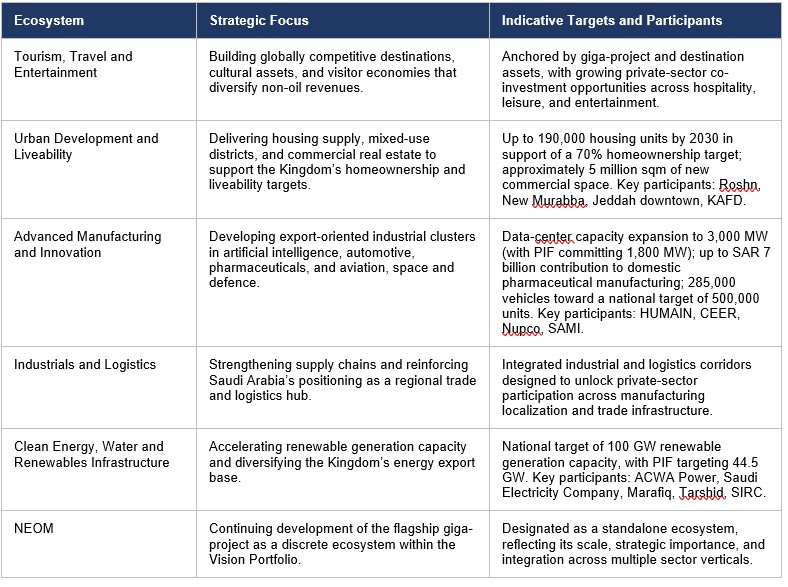
The Vision Portfolio is the engine of PIF’s domestic transformation agenda. It is designed to deepen integration across the Kingdom’s priority strategic sectors, maximize value across PIF portfolio companies, and sustain the growth of the local economy. Practically, the Vision Portfolio consolidates PIF’s existing 13 strategic sectors into six fully integrated economic ecosystems. It also creates new entry points for the domestic private sector to participate as investors, partners, and suppliers, while attracting international co-investors and operators.

Strategic Portfolio

The Strategic Portfolio focuses on actively managing PIF’s core national assets, optimizing returns from those holdings, and supporting selected portfolio companies in their journey to become global champions. It is the portfolio through which PIF expects to convert long-standing strategic positions into internationally scalable businesses capable of attracting both domestic and foreign capital.

Financial Portfolio

The Financial Portfolio is constructed to deliver sustainable, long-term risk-adjusted returns through diversified global investments. It is intended to strengthen PIF’s position as a global investor, reinforce portfolio resilience, and secure a durable funding base that underwrites PIF’s continued domestic investment firepower.

The six ecosystems at the heart of the Vision Portfolio

The Vision Portfolio’s six ecosystems represent a significant organizational shift. Rather than managing investments as a portfolio of discrete sector bets, PIF is explicitly designing these ecosystems to interconnect, so that demand generated in one vertical is captured by suppliers, operators, and infrastructure within another. The aim is to build competitive depth in the domestic economy and reduce reliance on imports and external providers in the sectors that matter most to Vision 2030.


From builder to architect: the shift in PIF’s posture

The most consequential feature of the 2026–2030 strategy is not a new sector or a new target, but a change in PIF’s role. The 2021–2025 cycle was defined by PIF acting as the primary buyer of record across entire value chains, underwriting demand and absorbing risk while domestic and international capacity was built. In the next five years, PIF is repositioning itself as the architect of those ecosystems, with the private sector expected to take on a materially larger share of capital deployment, execution, and operating risk.

Three features of the new strategy signal that shift. First, PIF has committed to structuring its portfolio around efficiency, value realization, and disciplined capital allocation, rather than growth for its own sake. Second, the Vision Portfolio is explicitly designed to unlock new opportunities for private-sector participation as investor, partner, and supplier. Third, PIF is expanding its international footprint, with subsidiary offices in North America, Europe, and Asia intended to deepen ties in priority markets and attract inbound capital, talent, and technology into the Kingdom.

For private-sector participants, whether Saudi national champions, regional groups, or international entrants, the implication is that the competitive advantage in the 2026–2030 cycle will increasingly accrue to those who can deploy capital, operate at scale, and integrate into PIF-backed ecosystems on genuinely commercial terms, rather than those seeking to sell into sovereign-backed demand.

Governance, transparency, and institutional excellence

The strategy elevates governance and institutional standards to a strategic objective. PIF has signalled that the next phase will apply the highest standards of governance, transparency, and institutional discipline across its portfolio companies, alongside advanced use of data and artificial intelligence in investment decision-making. For portfolio companies, this is likely to translate into more structured performance management, clearer reporting standards, and sharper scrutiny of capital efficiency. For advisors and service providers, it indicates sustained demand for audit, assurance, tax, legal, and transaction advisory services that can support investment-grade institutional requirements across an increasingly complex portfolio.

Implications for the market

The 2026–2030 strategy is best understood as a maturity milestone. The Kingdom has, in less than a decade, built the architecture of a diversified non-oil economy; the task now is to operate that architecture commercially, attract complementary private capital, and convert domestic scale into global competitiveness. Several implications follow for participants across the ecosystem.

  • Capital allocators can expect a growing pipeline of structured co-investment opportunities across the six ecosystems, supported by PIF’s Private Sector Forum and an expanding suite of partnership vehicles.
  • Operating companies and international entrants will find the clearest entry points in sectors aligned with the six ecosystems, notably advanced manufacturing, logistics, clean energy, tourism, urban development, and NEOM-related verticals.
  • Portfolio companies will need to demonstrate measurable contributions to non-oil GDP, export capability, and commercial returns, rather than relying solely on the scale of deployment.
  • Professional services firms, across audit, tax, legal, and strategic advisory, will play an increasingly central role in supporting the governance, transaction execution, and cross-border structuring that the next phase of the strategy demands.
Outlook

PIF’s 2026–2030 strategy sets a measured but ambitious course. It preserves the Fund’s unique mandate, consolidates the foundations laid during the 2021–2025 cycle, and signals a deliberate transition toward a more efficient, private-sector-led model of growth. For the Kingdom, the strategy strengthens the link between national transformation ambitions and credible, commercially disciplined delivery. For the market, it clarifies where capital, expertise, and partnership are most likely to be rewarded over the coming five years. And for institutions operating across the GCC, including professional advisors supporting inbound investors, national champions, and portfolio companies, it reinforces that the next phase of Saudi Arabia’s transformation will be defined less by the pace of deployment and more by the quality of execution.

Saudi Arabia Opens a New Lane for Institutional Fund Investment: What the CMA’s Simplified Investment Fund Framework Means for You

Saudi Arabia Opens a New Lane for Institutional Fund Investment

The Saudi Capital Market Authority has taken a notable step in reshaping the Kingdom’s investment landscape. On 2 March 2026, the CMA’s Board issued the Instructions of Simplified Investment Funds (the Instructions), a self-contained regulatory regime designed to sit alongside, rather than within, the existing Investment Funds Regulations.


For institutional market participants, private equity sponsors, venture capital managers, family offices, and sophisticated asset managers, this development deserves careful attention.

A Purpose-Built Framework

It would be a mistake to read the Instructions as merely a lighter version of the existing rules. They are better understood as a purpose-built channel, designed specifically to serve institutional deal flow that does not require the full apparatus of retail-facing fund regulation.

The Instructions govern the registration, management, and operation of Simplified Investment Funds from the ground up. Where a provision of the existing Investment Funds Regulations is meant to apply, the Instructions say so explicitly. Otherwise, the new regime stands on its own terms.

Who Can Manage and Who Can Invest

Fund managers operating under the Instructions must hold a CMA licence covering either investment management and fund operation, or investment management alone. One important qualification: managers licensed solely for investment management, without fund operation authority, cannot use this framework for real estate funds or for funds that invest in real estate assets.

On the investor side, the Instructions draw a clear line. Units may only be offered through private placement to institutional clients. Secondary market transfers are similarly restricted to that same category. The CMA retains discretion to approve offerings to other investor classes on request, though additional conditions will apply.

Faster to Market: The Notification Model

Perhaps the most commercially significant change is the move away from a pre-approval process. Under the existing Investment Funds Regulations, the CMA was required to review an offering application within 15 days of a fund’s ability to proceed. That requirement is gone.

In its place, fund managers must notify the CMA in writing before the intended offering date, submit a signed declaration in the prescribed form, attach the fund’s Terms and Conditions and offering documents, and pay the applicable registration fee. The process is leaner, but it is not without risk.

The CMA expressly reserves the right to raise objections after notification. Fund managers who wish to reduce that exposure can seek the CMA’s non-objection in advance, preserving the speed advantage of the new regime while building in a degree of regulatory comfort before launch. How the CMA administers this post-notification review in practice will be one of the key areas to watch as the framework beds in.

Custody: The General Rule and Its Exceptions

As a baseline, fund managers must appoint one or more custodians based in the Kingdom under a written agreement, and the custodians must be institutions licensed by the CMA to carry out custody activities. The custodian cannot be the fund manager, a sub-fund manager, or an affiliate of either.

Two exceptions are worth flagging:

  • Where a Simplified Investment Fund is structured as a Special Purpose Entity, the requirement to appoint a custodian falls away entirely. This will be particularly relevant for deal-by-deal or project-specific structures that are common in private markets.
  • Where the fund is a feeder fund, the prohibition on a custodian’s affiliation with the fund manager is relaxed, provided that the conditions set out in Article 25 of the Investment Funds Regulations are met.
Flexibility in Fund Documentation

The Instructions introduce meaningful flexibility in the structure of a fund’s Terms and Conditions. Rather than mandating conformity with prescribed annexes as the Investment Funds Regulations do, the Instructions identify the categories of information that must be covered: offering period, target capital, investment strategy and objectives, fee arrangements, and risk disclosures. How that information is presented is, within those parameters, a matter for the manager.

This shift allows Terms and Conditions to be tailored more directly to the fund’s strategy and investor base, without requiring structural conformity to a template designed for a broader universe of funds.

Manager Duties and Delegation

The Instructions preserve a clear accountability framework. Fund managers owe their duties to unitholders and remain liable for losses arising from fraud, wilful negligence, misconduct, or default. Core responsibilities, including accurate disclosure, asset valuation, risk management, and compliance monitoring, cannot be transferred away.

Delegation is permitted for operational functions. Sub-fund managers, fund operators, and distributors may be appointed, subject to the conditions in the Instructions. Foreign sub-fund managers may be engaged to manage investments held outside the Kingdom, provided that the regulatory standards of their home jurisdiction are at least equivalent to the CMA’s own.

Operational Obligations

Books and records must be retained for a minimum of ten years, or longer where they relate to pending proceedings. Annual financial statements are required, prepared in accordance with standards approved by the Saudi Organization for Chartered and Professional Accountants and audited by a CMA-registered auditor who meets applicable independence requirements.

Our Assessment

The Instructions represent a considered effort by the CMA to create a more agile, institutionally oriented pathway within Saudi Arabia’s capital markets. For fund managers who have found the existing regime better suited to retail fund structures, this is a genuine development, not a marginal one.

That said, the framework raises practical questions that will take time to resolve. The notification model’s interaction with the CMA’s post-launch objection right, the eligibility of specialist strategies such as private credit and direct lending, and the precise scope of the SPE custodian exemption are all areas where market participants will want clarity before committing to structures that rely on the new regime.

We are advising clients across the fund formation, private equity, and capital markets space on what the Instructions mean for their strategies. If you would like to discuss how this framework applies to your specific situation, please reach out to our team.

Saudi Arabia’s New Real Estate Ownership Law for Non-Saudis: Implications for Businesses and Investors

Saudi Arabia’s New Real Estate Ownership Law for Non-Saudis

Saudi Arabia has introduced a landmark Real Estate Ownership Law for Non-Saudis, approved by Royal Decree M14 and published on 25 July 2025. This legislation represents a significant reform in the Kingdom’s property sector, opening new avenues for investment while maintaining regulatory oversight and strategic safeguards. The law allows non-Saudi individuals, companies, nonprofit organisations and other legal entities to acquire property in Saudi Arabia under a regulated framework. Its introduction aligns closely with Saudi Vision 2030, which seeks to diversify the economy, attract foreign investment and modernise urban development.


Overview of the Law

The new law replaces the previous framework that restricted foreign property ownership and imposed capital thresholds and purpose-related limitations. Non-Saudis can now acquire property in specific geographic zones determined by the government. Ownership may include full title or other property rights such as usufruct or easements, provided that transactions are properly registered with the Real Estate General Authority. The law clarifies procedures for registration, rights in rem, and fee structures while imposing compliance requirements that are intended to enhance transparency and legal certainty.

Special restrictions remain in place for the holy cities of Mecca and Madinah. Ownership in these locations is subject to stricter conditions, reflecting the Kingdom’s effort to balance investment liberalisation with cultural and religious considerations. The law is scheduled to come into effect approximately six months after publication, around January 2026.

Objectives and Policy Intent

The legislation serves multiple strategic objectives. Primarily, it seeks to attract foreign direct investment into the Saudi real estate market, thereby supporting economic diversification and stimulating activity in non-oil sectors. By widening the scope of eligible buyers and investors, the law also aims to increase the supply and quality of residential, commercial, and industrial properties.

Furthermore, the law provides a regulated and transparent mechanism for property ownership, thereby boosting investor confidence and reducing legal uncertainty. It is designed to encourage private sector participation, enhance urban planning, and support sustainable development goals. The broader intent is to create a modern, globally competitive real estate market that aligns with the Kingdom’s Vision 2030 objectives.

Implications for Businesses in Saudi Arabia

The new law has several implications for businesses operating domestically. Real estate developers stand to benefit from an expanded pool of potential buyers, including foreign individuals, corporations, and investment funds. This could increase demand for residential and commercial properties and enhance project valuations.

Construction companies, property management firms, brokerage agencies and related service providers can expect increased opportunities as demand rises for new developments, facility management and professional services related to registration and compliance. Real estate investment funds and financial institutions may also find new opportunities to create investment vehicles or expand portfolios that include foreign-owned properties.

Employers and multinational corporations will have more flexibility to acquire office premises, logistics hubs and operational facilities. This supports long-term planning for regional headquarters and business operations while simplifying leasing and rental arrangements.

Implications for Foreign Investors and Global Businesses

For international investors, the law transforms Saudi real estate into a regulated and accessible asset class. Foreign individuals and institutional investors can acquire property with legal certainty, creating opportunities for portfolio diversification, real estate development partnerships, and long-term investment.

Multinational companies will benefit from the ability to own premises for operations, reducing reliance on leasing and improving cost predictability. Additionally, foreign participation can stimulate cross-border capital flows and increase the attractiveness of Saudi Arabia as a destination for expatriate talent and international investors.

However, investors must be mindful of geographic restrictions, especially in Mecca and Madinah, as well as compliance requirements related to registration, title deeds and fee structures. Understanding these rules will be essential to mitigate risk and optimise investment outcomes.

Considerations and Risks

While the law provides significant opportunities, businesses and investors must approach the market with careful planning. Implementation details, including the designation of geographic zones and precise regulatory requirements, will only be clarified in forthcoming regulations.

Compliance obligations regarding property registration, ownership rights and associated fees require careful attention. Noncompliance could result in legal or financial penalties. Additionally, the opening of the market to foreign capital may drive demand and prices, creating potential affordability challenges and market volatility.

For sensitive locations, such as the holy cities, strict rules remain in place, and investors must ensure that acquisitions align with permitted zones and approved procedures. Monitoring the Real Estate General Authority and related official announcements will be critical for understanding practical operational requirements.

Saudi Arabia’s Real Estate Ownership Law for Non-Saudis represents a transformative step for the Kingdom’s property sector. By broadening eligibility, introducing transparency and regulatory clarity, and aligning with strategic economic objectives, the law creates substantial opportunities for domestic businesses, developers, investors and multinational corporations. The legislation is designed to attract foreign capital, encourage real estate development and integrate Saudi Arabia more closely into global investment markets. Success for businesses and investors will depend on understanding the regulatory framework, adhering to compliance requirements and strategically planning for participation in this newly accessible and regulated property market.

Saudi Arabia’s Regulations on Real Estate Investment Funds: Implications for Businesses and Investors

Saudi Arabia’s Regulations on Real Estate Investment Funds

Saudi Arabia has introduced updated Regulations on Real Estate Investment Funds, marking a significant step in the development of the Kingdom’s real estate and investment sectors. The regulations establish a clear framework for the creation, management and operation of real estate investment funds, providing legal certainty for both domestic and foreign investors. These rules are designed to enhance transparency, protect investors, promote market efficiency, and encourage sustainable growth in the real estate sector.


Overview of the Regulations

The Regulations set out detailed requirements for licensing, fund structure, investment limits, governance and reporting obligations. They apply to all real estate investment funds operating within the Kingdom, including those managed by Saudi fund managers and by licensed foreign managers authorised to operate in the market. The aim is to create a regulated environment that supports long-term investment while mitigating risks to investors and the broader financial system.

Funds must be registered with the Capital Market Authority, and managers are required to meet fit and proper criteria. The Regulations define permissible types of real estate assets for investment, the conditions for liquidity management, and the procedures for valuation and reporting. These provisions ensure that fund operations are transparent and that investors are fully informed of risks and returns.

Objectives and Strategic Intent

The primary objective of the Regulations is to strengthen investor confidence in real estate investment funds. By providing a robust legal and regulatory framework, the Kingdom aims to attract capital from both domestic and international investors. The Regulations also support the development of a diversified real estate market, stimulate economic activity in related sectors such as construction and property management, and align with Saudi Vision 2030 by encouraging non-oil investment and private sector participation.

The rules encourage fund managers to operate in a professional and disciplined manner, with clear responsibilities and accountability. Governance provisions require independent oversight and risk management, which help maintain a stable investment environment and enhance the Kingdom’s capital markets’ international reputation.

Implications for Businesses in Saudi Arabia

For domestic real estate companies, the Regulations provide an opportunity to access new sources of capital through professionally managed investment funds. Developers can partner with fund managers to finance projects, expand portfolios, and improve liquidity. The framework also increases competition and incentivises higher standards of property management, transparency, and reporting.

Real estate services, including valuation, property management, brokerage, and advisory services, will experience growing demand as funds require professional support. Legal and accounting firms will play a key role in ensuring compliance with the Regulations, structuring fund operations, and providing ongoing audit and advisory services.

The Regulations also encourage innovation in fund design, allowing for the development of specialised funds targeting specific asset classes or market segments. This can provide businesses with greater flexibility in raising capital for projects ranging from residential developments to commercial properties and mixed-use investments.

Implications for Global Investors and International Market Participants

For foreign investors, the Regulations provide a clear and secure framework to participate in Saudi real estate investment. The licensing and governance requirements ensure that funds operate under internationally recognised standards, giving investors’ confidence in fund management and asset valuation.

International fund managers may establish or manage funds in Saudi Arabia, broadening the pool of investment expertise and bringing global best practices to the Kingdom. These regulations make Saudi Arabia a more attractive destination for cross-border real estate investment, potentially increasing inflows of foreign capital and supporting economic diversification objectives.

The Regulations also facilitate participation by institutional investors such as pension funds, insurance companies, and sovereign wealth funds. By providing a structured and regulated environment, they create opportunities for large-scale investment while maintaining investor protection and market stability.

Considerations and Risks

While the Regulations offer significant opportunities, compliance is critical. Fund managers must adhere strictly to licensing, governance, reporting, and investment restrictions. Failure to comply can result in penalties, suspension or revocation of licences.

Investors should carefully assess the risks associated with fund structures, asset valuations and liquidity conditions. Despite the regulatory protections, the performance of real estate assets may be influenced by market conditions, economic factors, and regulatory changes.

Ongoing monitoring of the Capital Market Authority’s guidance and market developments will be essential for both fund managers and investors to ensure funds operate effectively and in accordance with the Regulations.

The Regulations on Real Estate Investment Funds in Saudi Arabia provide a comprehensive legal and regulatory framework that strengthens the Kingdom’s investment environment. They offer opportunities for domestic developers, fund managers, and service providers, while providing foreign investors with a secure and transparent platform to invest in Saudi real estate. By enhancing governance, transparency, and investor protection, the Regulations support sustainable growth in the real estate sector and contribute to the Kingdom’s broader economic diversification objectives under Vision 2030. The introduction of these rules marks a significant milestone in the professionalisation and internationalisation of Saudi Arabia’s real estate investment market.

Saudi Arabia’s CMA Glossary: Clarifying Capital Market Terms and Implications for Businesses

Saudi Arabia’s CMA Glossary

Saudi Arabia’s Capital Market Authority (CMA) has published an official glossary of terms used in its regulatory framework. This glossary serves as an authoritative reference for terminology employed across Saudi capital market rules and regulations. While it does not create new obligations or amend existing laws, it plays a significant role in enhancing clarity, consistency, and transparency for issuers, investors and market intermediaries.


Purpose and Significance of the CMA Glossary

The primary purpose of the glossary is to standardise the interpretation of key terms used in CMA regulations. Technical terms such as securities, offering, issuer and continuing obligations are now clearly defined within an official legal context. This standardisation reduces the risk of misinterpretation and ensures that all parties involved in securities transactions operate with a shared understanding.

By providing clear definitions, the glossary supports regulatory coherence across various CMA regulations. It strengthens investor confidence by ensuring that the meaning of critical terms is consistent in offering documents, disclosure statements, and legal agreements. The glossary also provides guidance for legal practitioners, advisors, and corporate entities when structuring deals or drafting official documents.

Implications for Businesses in Saudi Arabia

Although the glossary does not impose new legal obligations, it has practical implications for businesses operating in Saudi Arabia. Companies issuing securities or engaging in capital market activities can now reference the glossary to ensure that their documentation aligns with CMA terminology. This helps reduce compliance risks and prevents misunderstandings that could result in regulatory scrutiny.

Legal and financial advisory firms will need to update templates, contracts, and prospectuses in line with the glossary definitions. Similarly, audit firms, valuation experts, and fund managers will benefit from clear definitions when assessing the classification of assets, securities, or transactions. Overall, the glossary reinforces good governance, transparency, and consistency in the Kingdom’s capital market practices.

Implications for International Investors and Market Participants

For global investors and foreign issuers, the glossary provides an essential reference point when engaging with Saudi capital markets. Understanding official definitions ensures that cross-border transactions, investment structures and compliance measures are properly aligned with CMA expectations.

International asset managers, investment banks, and intermediaries can use the glossary to improve accuracy in legal documents and reduce the risk of misinterpretation. The availability of a standardised reference also facilitates due diligence, helps assess investment risks and supports better decision making for global capital market participants seeking exposure to Saudi Arabia.

Limitations of the CMA Glossary

It is important to recognise that the glossary does not, by itself, change existing rules, create new rights, or impose new obligations. It does not alter investment regulations, ownership limits, licensing requirements, or reporting standards. Investors and businesses must continue to comply with the underlying CMA regulations, laws and relevant statutory requirements.

The glossary functions as a supportive tool rather than a reform measure. Its value lies in providing clarity and consistency in interpreting terms that appear in offering rules, disclosure regulations, and continuing obligations. Legal and business professionals should therefore use the glossary in conjunction with the full body of CMA regulations and relevant legislation.

Strategic Takeaways for Market Participants

Despite its limitations, the glossary has practical strategic value. Saudi companies should integrate the glossary definitions into their internal compliance frameworks and legal documentation. This ensures alignment with CMA terminology and reduces the likelihood of regulatory misinterpretation.

Advisory firms, auditors, underwriters and investment managers can leverage the glossary to standardise documents, strengthen governance practices and streamline regulatory processes. Foreign investors and international participants should use the glossary as a reference tool to enhance clarity in cross-border transactions and capital market operations in Saudi Arabia.

Overall, the glossary contributes to the development of a transparent, predictable, and professional market environment, supporting the broader objectives of the Kingdom’s Vision 2030 to attract investment and diversify the economy.

The CMA glossary represents a meaningful step towards clarity and standardisation in Saudi Arabia’s capital market regulations. While it does not create new rules, it ensures that all stakeholders operate with a shared understanding of key regulatory terms. For domestic businesses, it improves compliance and governance practices. For international investors and global market participants, it provides a reference point that supports accurate interpretation and effective engagement with Saudi capital markets.

Investment Dynamics in Saudi Arabia’s Pharmaceutical Sector

Investment Dynamics in Saudi Arabia’s Pharmaceutical Sector

Saudi Arabia’s pharmaceutical sector has become a central pillar of national economic diversification and healthcare development. Under Vision 2030, the Kingdom is actively encouraging domestic and foreign investment in pharmaceuticals as part of its broader strategy to strengthen healthcare resilience, expand local manufacturing capabilities, and reduce reliance on imports. This strategic focus has positioned the sector as a compelling destination for investors seeking long-term growth opportunities aligned with public policy priorities and rising healthcare demand.


Market Size Growth Trends and Demand Drivers

The pharmaceutical market in Saudi Arabia has experienced steady expansion driven by population growth, increasing life expectancy, and the rising prevalence of chronic and lifestyle related diseases. Greater healthcare coverage and continued investment in hospitals and clinical infrastructure have further stimulated demand for both generic and innovative medicines. These structural drivers support sustained market growth and create a favourable environment for investors across manufacturing, distribution, and related healthcare services.

Policy Frameworks and National Objectives

Government policy plays a defining role in shaping investment dynamics within the pharmaceutical sector. National strategies emphasise increased private sector participation, enhanced local production, and the development of advanced manufacturing and research capabilities. Programmes linked to Vision 2030 support partnerships between local and international companies, encourage technology transfer, and prioritise pharmaceutical self-sufficiency as a strategic objective. These policies provide long term visibility and confidence for investors planning capital intensive projects.

Regulatory Environment and Market Entry Requirements

The pharmaceutical sector in Saudi Arabia operates within a structured regulatory framework overseen by the Saudi Food and Drug Authority. Companies seeking to manufacture, import, or distribute pharmaceutical products must comply with licensing, product registration, and quality assurance requirements. Good Manufacturing Practice standards are strictly enforced to ensure product safety and efficacy. While regulatory compliance requires careful planning, recent regulatory developments aim to enhance efficiency and predictability for compliant market participants.

Localisation and Industrial Development Strategy

Localisation is a key factor influencing investment decisions in the pharmaceutical sector. The Kingdom has prioritised the development of domestic manufacturing capacity for finished pharmaceutical products, biologics, and active pharmaceutical ingredients. Investors are encouraged to establish local facilities or enter joint ventures that contribute to national industrial development goals. Local production is increasingly favoured in public procurement processes, reinforcing the commercial rationale for establishing operations within Saudi Arabia.

Investment Incentives and Financing Structures

Pharmaceutical investments benefit from a range of incentives designed to attract capital and expertise. These may include investment facilitation services, access to industrial land, and financial support mechanisms aligned with national development priorities. Public sector participation through strategic investment vehicles has also played a role in supporting large scale healthcare and pharmaceutical projects. These financing structures help reduce investment risk and promote long-term sector sustainability.

Innovation Research and Development Opportunities

Saudi Arabia is seeking to move beyond basic pharmaceutical manufacturing towards higher value activities including research, development, and advanced therapeutics. Investments in biologics, biosimilars, and clinical research are increasingly encouraged through partnerships with universities, research institutions, and healthcare providers. This evolving ecosystem offers investors opportunities to participate in innovation driven growth while contributing to national knowledge and capability building.

Operational and Supply Chain Considerations

Operational success in the pharmaceutical sector requires careful management of supply chains, quality systems, and skilled workforce development. Investors must address issues such as sourcing of raw materials, cold chain logistics, and compliance with international export standards. Building resilient operations and investing in local talent development are critical factors in achieving long term competitiveness and regulatory compliance.

Market Access Pricing and Procurement Dynamics

Commercial success also depends on understanding market access pathways and procurement practices. Public sector procurement remains a major channel for pharmaceutical sales, while private healthcare providers offer complementary opportunities for specialised and innovative products. Pricing frameworks and reimbursement considerations influence investment returns and must be integrated into market entry and expansion strategies.

The investment dynamics of Saudi Arabia’s pharmaceutical sector reflect a combination of strong demand fundamentals, supportive government policy, and a maturing regulatory environment. For investors prepared to align with localisation objectives and regulatory requirements, the sector offers a stable and strategically significant platform for growth. By adopting a long-term approach focused on compliance, operational excellence, and partnership, investors can play a meaningful role in the continued development of the Kingdom’s pharmaceutical industry.

Foreign Investment in Saudi Arabia: Legal Guidelines and Opportunities

Foreign Investment in Saudi Arabia: Legal Guidelines and Opportunities

Saudi Arabia continues to solidify its position as a major destination for international investment, driven by the ambitious goals of Vision 2030. The Kingdom has implemented comprehensive economic, regulatory, and structural reforms to diversify its economy beyond oil, enhance private sector participation, and attract foreign investment. For investors seeking long-term value, understanding the legal framework and sectoral opportunities in Saudi Arabia is critical to successful market entry and sustainable operations.


Legal Framework and Regulatory Environment

Saudi Arabia’s legal system is grounded in Sharia law, yet has undergone significant modernisation to align with global investment standards. The Ministry of Investment (MISA) remains the key authority responsible for facilitating foreign investment, issuing licences, and coordinating investor support. Through initiatives like Invest Saudi, MISA actively promotes sector-specific investment opportunities and provides regulatory clarity to support these endeavours.

The Foreign Investment Law, initially issued in 2000 and progressively updated, guarantees equal treatment for foreign and domestic investors in most sectors, subject to regulatory compliance. Recent reforms include enhancements to the Companies Law (2022) and Bankruptcy Law, providing more flexibility in corporate structuring, clearer dispute resolution processes, and investor protections.

Licensing and Ownership Structures

To operate in Saudi Arabia, foreign investors must obtain an investment licence from MISA. The process has been digitised through platforms like Meras and Tayseer, allowing submission of business plans, financial records, and legal documents through a single portal.

Most sectors now allow 100% foreign ownership, including in services, manufacturing, education, healthcare, logistics, and technology. However, some activities remain subject to the Negative List, which is periodically reviewed and updated. Specific strategic or sensitive sectors may require a local partner or meet national security criteria.

Permissible legal structures include:

  • Limited Liability Company (LLC)
  • Joint Stock Company (JSC)
  • Branch of a foreign company
  • Representative office (for market studies and non-commercial activity)
Strategic Sector Opportunities

Saudi Arabia’s economic diversification drive has created robust opportunities across several high-growth sectors:

  • Energy Transition and Renewables: While oil and gas remain vital, significant investments are being made in green energy through the Saudi Green Initiative, NEOM’s Enowa, and public-private partnerships in solar, wind, hydrogen, and carbon capture.
  • Tourism, Entertainment, and Culture: Projects such as The Red Sea, Qiddiya, and Diriyah Gate are transforming Saudi Arabia’s tourism sector. The Ministry of Tourism is actively issuing licences for hospitality, events, and heritage ventures, backed by the Tourism Investment Fund.
  • Technology and Digital Economy: With a national push towards digitalisation, sectors like artificial intelligence, fintech, e-commerce, cloud computing, and cybersecurity are rapidly growing. Initiatives such as the National Transformation Program (NTP) and Digital Government Authority offer partnership opportunities for tech firms.
  • Real Estate and Urban Development: Flagship developments in Riyadh, Jeddah, and NEOM have driven demand in housing, smart cities, commercial infrastructure, and industrial zones. Foreign investors can participate directly in real estate development through approved licences.
  • Healthcare and Life Sciences: The healthcare sector is undergoing privatisation, opening investment channels in hospitals, pharmaceuticals, medical devices, and telehealth. Regulatory oversight is provided by the Saudi Food and Drug Authority (SFDA) and the Ministry of Health.
Incentives for Foreign Investors

Saudi Arabia has introduced a range of fiscal and operational incentives to enhance competitiveness:

  • Special Economic Zones (SEZs) offering custom tax regimes, streamlined customs, and relaxed ownership rules
  • Customs exemptions for capital equipment and raw materials
  • No personal income tax, with competitive corporate tax rates
  • Full repatriation of capital and profits
  • Long-term residency (Premium Residency) programs for foreign investors and talent

SEZs, such as King Abdullah Economic City (KAEC) and the recently launched Riyadh Integrated SEZ, cater to advanced manufacturing, logistics, biotechnology, and digital services.

Legal Compliance and Governance

Foreign investors must comply with national regulatory obligations, including:

  • Labour Law and Saudisation (Nitaqat): Mandatory quotas for employing Saudi nationals
  • Tax and Zakat compliance: Including VAT (15%), Withholding Tax, and Zakat for Saudi/GCC shareholders
  • Intellectual Property (IP) registration with the Saudi Authority for Intellectual Property (SAIP)
  • Contract enforcement through bilingual documentation and arbitration options via the Saudi Center for Commercial Arbitration (SCCA)

Saudi Arabia also actively supports ESG-aligned investments and is enhancing its regulatory frameworks for sustainability disclosures and responsible governance.

Saudi Arabia presents a compelling investment landscape, underpinned by a modern legal framework, government support, and extensive infrastructure projects. With strategic reforms, a young population, and access to regional and global markets, the Kingdom is well-positioned for foreign investors seeking long-term returns. Those who engage proactively with local regulations, cultural practices, and policy shifts will find substantial opportunity in contributing to the Kingdom’s transformation journey.


Real Estate Laws in Saudi Arabia: Investment Opportunities and Legal Requirements

Real Estate Laws in Saudi Arabia: Investment Opportunities and Legal Requirements

Saudi Arabia has emerged as one of the most dynamic real estate markets in the Middle East, driven by its Vision 2030 agenda, rapid urban transformation, and ambitious economic diversification goals. The sector’s ongoing liberalisation, especially the historic opening of the market to foreign ownership, is unlocking unprecedented investment opportunities across residential, commercial, and industrial real estate.


A Transformative Legal Landscape

Over the last several years, Saudi Arabia has significantly overhauled its legal framework to make the real estate sector more accessible, transparent, and investor-friendly. The cornerstone of these reforms was the 2023 Cabinet approval permitting full property ownership by foreign individuals and entities, including in key urban centres such as Riyadh, Jeddah, and Dammam. This change marks a major departure from previous restrictions and underscores the Kingdom’s commitment to attracting global capital.

However, restrictions still apply in Mecca and Medina, where non-Saudis are not permitted to own property. Outside these areas, foreign investors can acquire real estate subject to regulatory approval and licensing through the Ministry of Investment (MISA).

Investment Opportunities in a Fast-Growing Market

Several national megaprojects are powering Saudi Arabia’s real estate boom:

  • NEOM, the futuristic smart city
  • The Red Sea Project, focused on luxury eco-tourism
  • Qiddiya, an entertainment and sports hub
  • Diriyah Gate, a heritage urban development

These projects offer direct entry points for global developers, institutional investors, construction companies, and hospitality operators.

Meanwhile, Riyadh’s transformation into a global city is catalysing demand for commercial, mixed-use, and residential developments. The growing expatriate population, government relocation plans, and international business inflows are intensifying interest in the capital’s real estate sector.

The Premium Residency Program, updated in 2024, now offers expanded benefits, including multi-property ownership, investor visas, and family sponsorship, targeting high-net-worth individuals and skilled professionals.

Legal Requirements for Real Estate Investment

Foreign investors must meet specific legal conditions to operate in the Saudi property market:

1. Foreign Ownership and Licensing

  • 100% ownership is now permitted in most areas, but registration through MISA is mandatory
  • A valid commercial licence must be obtained for real estate development, leasing, brokerage, or facility management
  • Investment in strategic or restricted zones may require additional government approvals

2. Due Diligence and Title Verification

  • Investors should validate land titles via the “Sak” digital real estate registration system, which is now mandatory for all formal property transactions
  • Zoning compliance, environmental clearance, and land-use approvals must be verified before acquisition

3. Contracting Standards

  • Contracts must be written in Arabic and comply with Saudi contract law
  •  It is advisable to engage bilingual legal counsel with experience in Saudi property law, particularly for large or long-term commercial deals

4. Tax and Financial Obligations

  • Real Estate Transaction Tax (RETT): 5% on the value of the property transfer
  • Value Added Tax (VAT): 15% may apply on real estate services (e.g., brokerage, management)
  • The recent 2024 guidelines issued by ZATCA clarify that mixed-use property transactions must allocate taxable vs exempt components appropriately

5. Dispute Resolution

  • Disputes may be resolved through Specialised Real Estate Courts or commercial arbitration, including via the Saudi Center for Commercial Arbitration (SCCA)
  • Saudi Arabia is a signatory to the New York Convention, supporting the enforceability of foreign arbitral awards
Strategic Considerations for Foreign Investors

Investors should adopt a long-term strategy aligned with Vision 2030, incorporating:

  • Joint ventures with local developers or sovereign-backed real estate funds
  • Smart-city and ESG-aligned project design, which is increasingly favoured by regulators and urban planners
  • Engagement with government-backed infrastructure and public-private partnership (PPP) models to gain strategic access

Additionally, green building standards, climate-adaptive architecture, and energy-efficient developments are being promoted through sustainability regulations under the Ministry of Municipal, Rural Affairs and Housing.

Saudi Arabia’s real estate sector is entering a transformative era characterised by legal liberalisation, mega-infrastructure projects, and the integration of foreign investors. With supportive regulation, strong government backing, and rising demand in key cities, the Kingdom offers significant potential for real estate developers, institutional investors, and asset managers. To unlock these opportunities, investors must remain attuned to the evolving legal landscape, tax obligations, and strategic entry routes available within one of the fastest-growing property markets in the world.