
Saudi Arabia’s CMA Glossary: Clarifying Capital Market Terms and Implications for Businesses

Saudi Arabia’s Capital Market Authority (CMA) has published an official glossary of terms used in its regulatory framework. This glossary serves as an authoritative reference for terminology employed across Saudi capital market rules and regulations. While it does not create new obligations or amend existing laws, it plays a significant role in enhancing clarity, consistency, and transparency for issuers, investors and market intermediaries.


Purpose and Significance of the CMA Glossary

The primary purpose of the glossary is to standardise the interpretation of key terms used in CMA regulations. Technical terms such as securities, offering, issuer and continuing obligations are now clearly defined within an official legal context. This standardisation reduces the risk of misinterpretation and ensures that all parties involved in securities transactions operate with a shared understanding.

By providing clear definitions, the glossary supports regulatory coherence across various CMA regulations. It strengthens investor confidence by ensuring that the meaning of critical terms is consistent in offering documents, disclosure statements, and legal agreements. The glossary also provides guidance for legal practitioners, advisors, and corporate entities when structuring deals or drafting official documents.

Implications for Businesses in Saudi Arabia

Although the glossary does not impose new legal obligations, it has practical implications for businesses operating in Saudi Arabia. Companies issuing securities or engaging in capital market activities can now reference the glossary to ensure that their documentation aligns with CMA terminology. This helps reduce compliance risks and prevents misunderstandings that could result in regulatory scrutiny.

Legal and financial advisory firms will need to update templates, contracts, and prospectuses in line with the glossary definitions. Similarly, audit firms, valuation experts, and fund managers will benefit from clear definitions when assessing the classification of assets, securities, or transactions. Overall, the glossary reinforces good governance, transparency, and consistency in the Kingdom’s capital market practices.

Implications for International Investors and Market Participants

For global investors and foreign issuers, the glossary provides an essential reference point when engaging with Saudi capital markets. Understanding official definitions ensures that cross-border transactions, investment structures and compliance measures are properly aligned with CMA expectations.

International asset managers, investment banks, and intermediaries can use the glossary to improve accuracy in legal documents and reduce the risk of misinterpretation. The availability of a standardised reference also facilitates due diligence, helps assess investment risks and supports better decision making for global capital market participants seeking exposure to Saudi Arabia.

Limitations of the CMA Glossary

It is important to recognise that the glossary does not, by itself, change existing rules, create new rights, or impose new obligations. It does not alter investment regulations, ownership limits, licensing requirements, or reporting standards. Investors and businesses must continue to comply with the underlying CMA regulations, laws and relevant statutory requirements.

The glossary functions as a supportive tool rather than a reform measure. Its value lies in providing clarity and consistency in interpreting terms that appear in offering rules, disclosure regulations, and continuing obligations. Legal and business professionals should therefore use the glossary in conjunction with the full body of CMA regulations and relevant legislation.

Strategic Takeaways for Market Participants

Despite its limitations, the glossary has practical strategic value. Saudi companies should integrate the glossary definitions into their internal compliance frameworks and legal documentation. This ensures alignment with CMA terminology and reduces the likelihood of regulatory misinterpretation.

Advisory firms, auditors, underwriters and investment managers can leverage the glossary to standardise documents, strengthen governance practices and streamline regulatory processes. Foreign investors and international participants should use the glossary as a reference tool to enhance clarity in cross-border transactions and capital market operations in Saudi Arabia.

Overall, the glossary contributes to the development of a transparent, predictable, and professional market environment, supporting the broader objectives of the Kingdom’s Vision 2030 to attract investment and diversify the economy.

The CMA glossary represents a meaningful step towards clarity and standardisation in Saudi Arabia’s capital market regulations. While it does not create new rules, it ensures that all stakeholders operate with a shared understanding of key regulatory terms. For domestic businesses, it improves compliance and governance practices. For international investors and global market participants, it provides a reference point that supports accurate interpretation and effective engagement with Saudi capital markets.

Investment Dynamics in Saudi Arabia’s Pharmaceutical Sector

Saudi Arabia’s pharmaceutical sector has become a central pillar of national economic diversification and healthcare development. Under Vision 2030, the Kingdom is actively encouraging domestic and foreign investment in pharmaceuticals as part of its broader strategy to strengthen healthcare resilience, expand local manufacturing capabilities, and reduce reliance on imports. This strategic focus has positioned the sector as a compelling destination for investors seeking long-term growth opportunities aligned with public policy priorities and rising healthcare demand.


Market Size Growth Trends and Demand Drivers

The pharmaceutical market in Saudi Arabia has experienced steady expansion driven by population growth, increasing life expectancy, and the rising prevalence of chronic and lifestyle related diseases. Greater healthcare coverage and continued investment in hospitals and clinical infrastructure have further stimulated demand for both generic and innovative medicines. These structural drivers support sustained market growth and create a favourable environment for investors across manufacturing, distribution, and related healthcare services.

Policy Frameworks and National Objectives

Government policy plays a defining role in shaping investment dynamics within the pharmaceutical sector. National strategies emphasise increased private sector participation, enhanced local production, and the development of advanced manufacturing and research capabilities. Programmes linked to Vision 2030 support partnerships between local and international companies, encourage technology transfer, and prioritise pharmaceutical self-sufficiency as a strategic objective. These policies provide long term visibility and confidence for investors planning capital intensive projects.

Regulatory Environment and Market Entry Requirements

The pharmaceutical sector in Saudi Arabia operates within a structured regulatory framework overseen by the Saudi Food and Drug Authority. Companies seeking to manufacture, import, or distribute pharmaceutical products must comply with licensing, product registration, and quality assurance requirements. Good Manufacturing Practice standards are strictly enforced to ensure product safety and efficacy. While regulatory compliance requires careful planning, recent regulatory developments aim to enhance efficiency and predictability for compliant market participants.

Localisation and Industrial Development Strategy

Localisation is a key factor influencing investment decisions in the pharmaceutical sector. The Kingdom has prioritised the development of domestic manufacturing capacity for finished pharmaceutical products, biologics, and active pharmaceutical ingredients. Investors are encouraged to establish local facilities or enter joint ventures that contribute to national industrial development goals. Local production is increasingly favoured in public procurement processes, reinforcing the commercial rationale for establishing operations within Saudi Arabia.

Investment Incentives and Financing Structures

Pharmaceutical investments benefit from a range of incentives designed to attract capital and expertise. These may include investment facilitation services, access to industrial land, and financial support mechanisms aligned with national development priorities. Public sector participation through strategic investment vehicles has also played a role in supporting large scale healthcare and pharmaceutical projects. These financing structures help reduce investment risk and promote long-term sector sustainability.

Innovation Research and Development Opportunities

Saudi Arabia is seeking to move beyond basic pharmaceutical manufacturing towards higher value activities including research, development, and advanced therapeutics. Investments in biologics, biosimilars, and clinical research are increasingly encouraged through partnerships with universities, research institutions, and healthcare providers. This evolving ecosystem offers investors opportunities to participate in innovation driven growth while contributing to national knowledge and capability building.

Operational and Supply Chain Considerations

Operational success in the pharmaceutical sector requires careful management of supply chains, quality systems, and skilled workforce development. Investors must address issues such as sourcing of raw materials, cold chain logistics, and compliance with international export standards. Building resilient operations and investing in local talent development are critical factors in achieving long term competitiveness and regulatory compliance.

Market Access Pricing and Procurement Dynamics

Commercial success also depends on understanding market access pathways and procurement practices. Public sector procurement remains a major channel for pharmaceutical sales, while private healthcare providers offer complementary opportunities for specialised and innovative products. Pricing frameworks and reimbursement considerations influence investment returns and must be integrated into market entry and expansion strategies.

The investment dynamics of Saudi Arabia’s pharmaceutical sector reflect a combination of strong demand fundamentals, supportive government policy, and a maturing regulatory environment. For investors prepared to align with localisation objectives and regulatory requirements, the sector offers a stable and strategically significant platform for growth. By adopting a long-term approach focused on compliance, operational excellence, and partnership, investors can play a meaningful role in the continued development of the Kingdom’s pharmaceutical industry.

Convertible Financing in Saudi Arabia: Legal, Regulatory and Shariah Considerations

As Saudi Arabia’s startup and venture ecosystem matures, founders and investors are increasingly exploring flexible financing tools that bridge the gap between early-stage funding and priced equity rounds.


Convertible instruments such as Convertible Notes, SAFEs and KISS structures are becoming more common in discussions, yet their use in the Kingdom requires careful navigation of company law, regulatory approvals and Shariah principles. This article outlines how convertible financing operates in the Saudi context, the key distinctions between instruments, and the practical considerations that companies and investors must address to ensure enforceability and compliance.

Understanding Convertible Instruments in KSA

Convertible financing refers to funding structures where an investor provides capital today with the expectation that it will convert into equity at a later stage, typically upon a qualifying financing round.

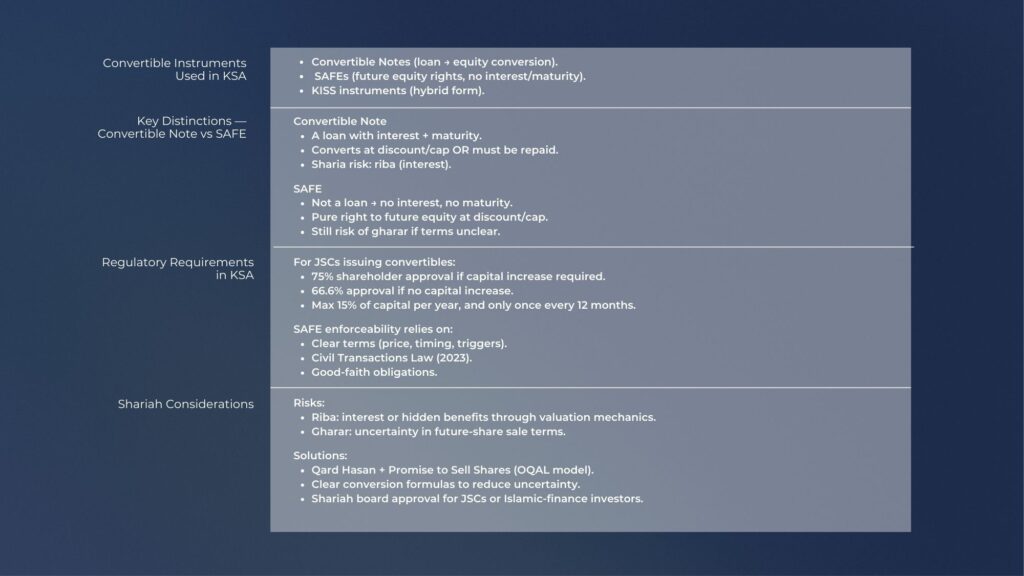
The most commonly discussed instruments in Saudi Arabia include:

  • Convertible notes, which are structured as loans that may convert into equity at a later date.
  • SAFEs (Simple Agreements for Future Equity), which provide a contractual right to receive equity in the future without being classified as debt.
  • KISS instruments, which sit somewhere between notes and SAFEs, are less commonly used in the Saudi market.

While these instruments are familiar to international venture capital investors, their application in Saudi Arabia is not a direct “plug-and-play” exercise and must be adapted to local legal and Shariah frameworks.

Convertible Notes vs SAFEs: Key Legal Differences

A Convertible Note is, at its core, a loan. It typically carries interest and has a maturity date, at which point the note either converts into equity (often at a discount or valuation cap) or must be repaid. In Saudi Arabia, this structure raises immediate Shariah concerns, as interest-bearing loans may be viewed as riba. In addition, maturity and repayment obligations can introduce balance sheet and insolvency considerations for early-stage companies.

A SAFE, by contrast, is not a loan. It accrues no interest and has no maturity date. Instead, it gives the investor a contractual right to acquire equity in the future upon the occurrence of defined events, such as a priced equity round. While SAFEs avoid many RIBA-related issues, they can still face gharar risks if the terms around conversion, valuation or timing are insufficiently clear.

Regulatory Requirements for Saudi Companies

From a corporate law perspective, the use of convertible instruments depends heavily on the company’s legal form, particularly for Joint Stock Companies (JSCs). Where a convertible instrument ultimately requires a capital increase, Saudi regulations typically require shareholder approval of at least 75%. If no capital increase is triggered at issuance, a lower 66.6% threshold may apply. In addition, capital increases are generally capped at 15% of share capital per year and may be undertaken only once every 12 months.

For SAFEs, enforceability does not stem from specific “SAFE legislation” but rather from general contract principles under Saudi law, including the Civil Transactions Law (2023). Clear drafting defined triggers and demonstrable good faith are therefore critical to reducing legal uncertainty.

Shariah Considerations: Risks and Mitigations

The two principal Shariah risks associated with convertible financing are riba and gharar.

  • Riba concerns may arise when interest is charged or when valuation mechanics result in hidden or disproportionate economic benefits to the investor.
  • Gharar may arise if the future sale of shares is subject to excessive uncertainty, such as undefined conversion prices or open-ended timelines.

To address these risks, market participants in Saudi Arabia often adopt alternative or modified structures. These may include interest-free funding arrangements (Qard Hasan) combined with a separate promise to sell shares in the future, or carefully drafted SAFEs with transparent conversion formulas, valuation caps and discounts. For companies with Shariah-sensitive investor bases, obtaining Shariah board approval is often advisable.

Practical and Legal Challenges

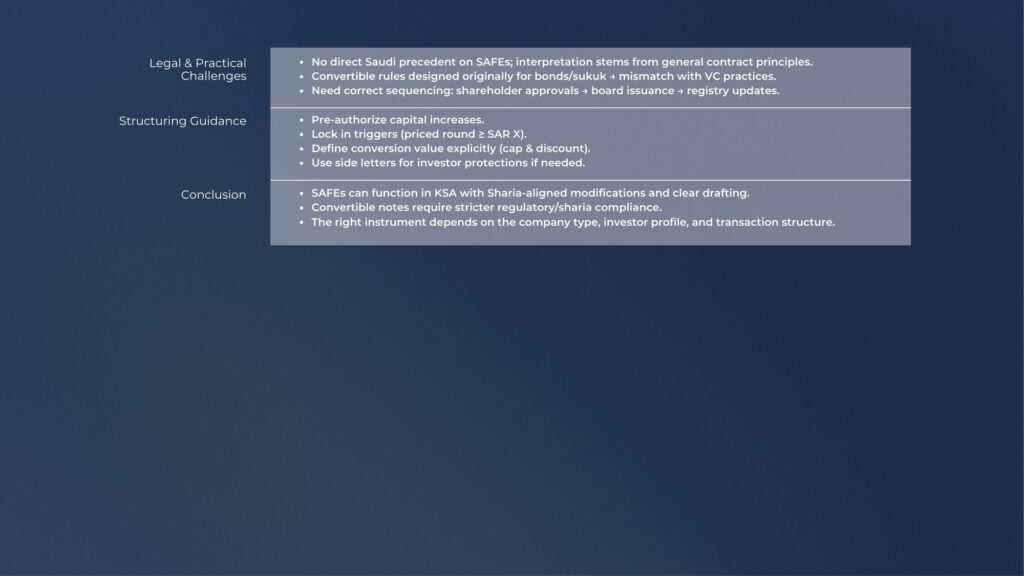
Despite growing market familiarity, there is still no direct Saudi judicial precedent dealing specifically with SAFEs. Their enforceability relies on broader contractual interpretation rather than instrument-specific guidance. In addition, Saudi convertible rules were historically designed with bonds and sukuk in mind, which can create friction when applied to venture-style financing.

Process discipline is therefore essential. Companies must ensure the correct sequencing of approvals, from shareholder resolutions to board issuances and commercial registry updates. Failure to do so can undermine the instrument’s validity or delay conversion at a critical growth stage.

Structuring Convertible Financing Effectively

Well-structured convertible financings in Saudi Arabia typically share several features. These include pre-authorised capital increases, clearly defined conversion triggers (such as a priced round above a stated valuation), and explicit conversion mechanics setting out caps and discounts. Where additional investor protections are required, these are often addressed through side letters rather than over-complicating the core instrument.

Convertible financing can play a valuable role in supporting early-stage and growth companies in Saudi Arabia, but it must be approached with care. SAFEs can be made to function effectively when drafted with clarity and adapted to Shariah considerations, while convertible notes demand stricter scrutiny from both a regulatory and religious perspective. Ultimately, the choice of instrument depends on the company’s legal form, the investor profile, and the broader transaction structure. With thoughtful structuring and robust documentation, convertible financing can align international venture practices with Saudi legal and cultural requirements.

In Summary:

AI Laws & Regulatory Frameworks in the United Arab Emirates and Saudi Arabia

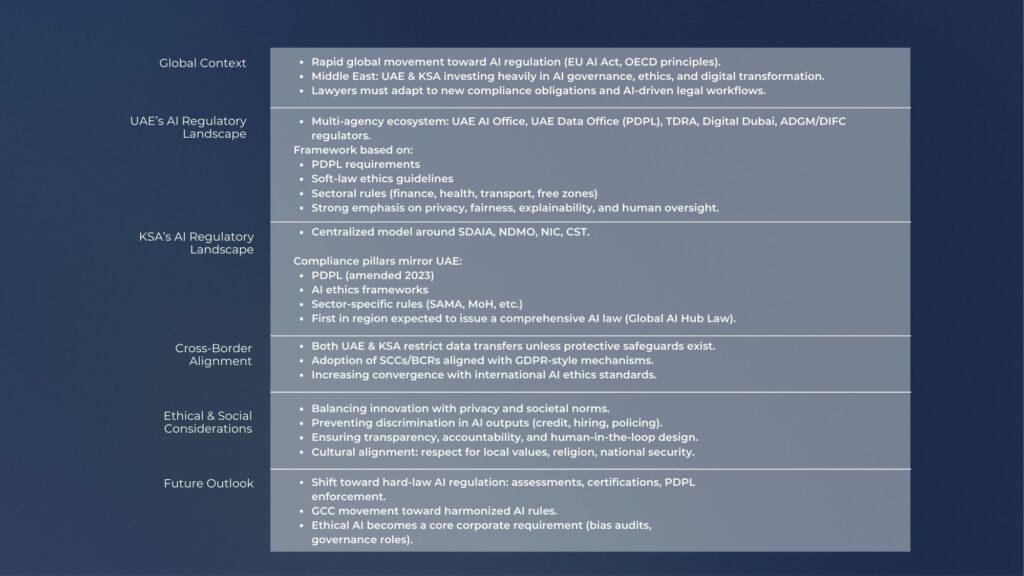
Artificial Intelligence (AI) has leapt from an emerging technology to a strategic pillar of economic, social, and governmental transformation across the Gulf. Both the United Arab Emirates (UAE) and the Kingdom of Saudi Arabia (KSA) have integrated AI into their national visions, targeting sustainable growth, digital leadership, and global competitiveness. Governing AI is not just about vision; it is about legal frameworks that balance innovation with ethics, security, and individual rights.


In this context, the regulatory landscapes in the UAE and KSA are evolving rapidly, blending legal structures, ethical principles, sector-specific guidance, and forward-looking frameworks that prepare the region for the next generation of digital transformation.

The UAE: A Multi-Layered Regulatory Ecosystem

In the UAE, AI governance is not yet encapsulated in one single AI statute but is governed through a combination of data protection laws, ethical principles, guidelines, and strategic national policies.

Strategic Foundations

The UAE was one of the first countries globally to institutionalise AI at the federal level. In 2017, it appointed a Minister of State for Artificial Intelligence and introduced the National Strategy for Artificial Intelligence 2031, which places AI at the heart of economic competitiveness and public service delivery.

Legal and Compliance Landscape

While there is no stand-alone AI law covering all AI systems, AI is regulated through existing legal frameworks, especially those related to personal data and privacy. The Federal Personal Data Protection Law (PDPL): Federal Decree-Law No. 45 of 2021 governs how personal data, often used in AI training and processing, must be collected, processed, and stored. It includes consent requirements and safeguards aligned with international norms. Free Zone Data Regulations in financial free zones such as the Dubai International Financial Centre (DIFC) and Abu Dhabi Global Market (ADGM) apply bespoke data regimes, some of which include AI-specific components.

Ethics and Principles

Overlaying the legal structures are ethical AI principles that emphasise transparency, fairness, explainability, accountability, privacy, and alignment with human values. The UAE’s AI Principles and Ethics framework articulates these core standards, reinforcing trust and safety in AI deployment across sectors.

Sector-Specific Guidance

Regulators in healthcare, finance, and transportation are increasingly issuing targeted guidance to ensure AI in sensitive contexts adheres to both general law and industry standards.

Saudi Arabia: Strategic Growth with Emerging Regulation

Saudi Arabia’s approach to AI law is similarly progressive but distinctive in its structure. With AI designated a strategic priority under Vision 2030, the Kingdom is building an ecosystem that promotes innovation while embedding ethical and governance guardrails.

Central Governance: SDAIA

The Saudi Data and Artificial Intelligence Authority (SDAIA) serve as the national reference body for data and AI strategy. Established by royal decree in 2019, SDAIA coordinates AI policy, data governance, and ethical guidelines across government and industry.

Legal Backdrop and Ethics

Currently, AI activities in Saudi Arabia are regulated through a combination of related laws and influential non-binding frameworks. The Personal Data Protection Law (PDPL) became effective in 2023 and sets rules for data controllers, processing conditions, breach notification timelines, and fines. SDAIA has issued AI ethics guidelines emphasising fairness, transparency, accountability, and human oversight. Specific guidance on emerging technologies, such as large language models, clarifies content authenticity and governance expectations.

Draft and Forthcoming AI Law

Saudi Arabia is developing a dedicated AI regulatory framework to support its position as a global AI innovation hub, foster investment in advanced digital technologies, enable scalable sovereign data infrastructure, and potentially introduce jurisdictional models for foreign AI services within defined legal structures. This anticipated law signals the Kingdom’s intention to create a more holistic AI-specific legal framework that complements broader economic and digital goals.

Comparatives
Aspect UAE Saudi Arabia
AI Law in Force No single comprehensive AI law; regulated via PDPL, ethical principles, sector rules No current standalone AI law: PDPL and ethics guidelines apply; draft AI law in development
Data Protection Federal PDPL plus Free Zone regulations PDPL 2023 with strict local requirements
Ethics and Governance National ethical principles and strategic framework SDAIA ethics principles and adoption guidance
Innovation Focus Early adopter with strategic integration across sectors Strategic emphasis on AI hub status and robust regulations
Key Themes in AI Regulation


Innovation with Responsibility

Regulators emphasise the importance of maintaining technological advancement while embedding ethical safeguards against bias, opacity, and misuse.

Data Privacy as Regulatory Foundation

Because AI depends heavily on data, personal data protection regimes like PDPL are the legal cornerstone of AI governance in both the UAE and Saudi Arabia.

Sector-Driven Oversight

Healthcare, finance, and critical infrastructure have tailored guidance reflecting risk and public interest.

Toward Unified AI Laws

Both nations are moving toward more formal AI regulatory frameworks, signalling that current structures are transitional stages in a rapidly evolving legal environment.

Implications for Businesses and Practitioners

Organisations deploying or developing AI solutions in the UAE or Saudi Arabia must ensure PDPL compliance for any personal data processing, adopt ethical AI practices aligned with national principle frameworks, monitor regulatory developments, including Saudi Arabia’s forthcoming AI law, and implement governance, risk, and compliance frameworks that embed AI lifecycle oversight and accountability.

The UAE and Saudi Arabia are shaping AI governance with strategic, layered frameworks that encourage innovation, protect individual rights, and foster ethical AI ecosystems. While neither country has yet enacted a comprehensive, standalone AI law, the combination of data protection legislation, ethical principles, draft laws, and sector guidance offers a robust, rapidly maturing regulatory environment. Staying informed and proactive in compliance is a key differentiator for businesses operating across the Gulf.

In summary:

A New Era for Arbitration in Saudi Arabia: Global Alignment in Focus

Saudi Arabia is preparing to overhaul its arbitration framework with a new draft law that promises to bring its dispute resolution regime in line with international best practices. Released for consultation in September 2025, this draft builds on the reforms of the 2012 Arbitration Law and is aligned with the Kingdom’s Vision 2030 goals.


Key Innovations
  • Governing Law Clarity: The draft affirms parties’ freedom to choose the law governing their arbitration agreement. In the absence of choice, the law of the seat applies, mirroring reforms in countries like the UK.
  • Broader Arbitrator Pool & Immunity: Arbitrators no longer need a Sharia or law degree. They’re protected from civil liability unless misconduct is proven, enhancing neutrality and diversity in appointments.
  • Joinder & Consolidation: The draft introduces mechanisms for multi-party and multi-contract disputes, allowing arbitrations to be joined or consolidated when parties agree, improving procedural efficiency.
  • Stronger Interim Relief: Arbitral tribunals can issue enforceable interim measures, and emergency arbitrators are formally recognized, allowing rapid responses to urgent issues before a final award.
  • Tech-Driven Procedures: Digital communication, electronic signatures, and virtual hearings are expressly allowed. Partial awards are now enforceable, and parties have flexibility over arbitration language and format.
  • Enforcement and Annulment Reforms: Courts can suspend annulment actions to allow correction of technical award defects. Enforcement decisions (grants or refusals) are now appealable. Awards (foreign or domestic) carry res judicata effect.
Practical Impact

These reforms will:

  • Increase certainty in contract drafting and enforcement;
  • Encourage use of top-tier arbitrators;
  • Streamline complex dispute resolution;
  • Reduce tactical delay and costs;
  • Improve confidence in Saudi Arabia as an arbitration seat.
Action Points for Businesses
  • Review arbitration clauses for clarity on governing law;
  • Opt into modern procedural rules (e.g., via SCCA or ICC);
  • Prepare for interim relief processes;
  • Monitor for the final enacted text and implementing regulations.

Once enacted, Saudi Arabia’s new arbitration law is expected to transform the Kingdom into a modern, arbitration-friendly jurisdiction, attractive to international parties while preserving core legal principles. It marks a pivotal step in reinforcing Saudi Arabia’s position as a reliable and competitive forum for dispute resolution in the Middle East and beyond.

A New Chapter for Arbitration in Saudi Arabia: Modernizing to Meet Global Standards

The Kingdom of Saudi Arabia (the “Kingdom”) is preparing to usher in a new era in its arbitration framework through the release of a draft Arbitration Law for public consultation. The initiative marks the most comprehensive reform of the system since the 2012 Arbitration Law (Royal Decree No. M/34) and forms part of the Kingdom’s wider Vision 2030 strategy to enhance investor confidence and the rule of law. Following a July 2025 resolution of the Council of Ministers calling for arbitration reform, the draft law, issued through the national competitiveness center, seeks to align Saudi practice with international norms and reinforce the Kingdom’s position as a regional center for commercial dispute resolution.


Over the past decade, Saudi Arabia has steadily built credibility as an arbitration-friendly jurisdiction. The 2012 law, which drew heavily on the UNCITRAL Model Law, introduced party autonomy and procedural predictability. The creation of the Saudi Center for Commercial Arbitration (“SCCA”) in 2017 further professionalized case administration, and Saudi courts have increasingly demonstrated deference to arbitral awards, including the enforcement of foreign awards under the New York Convention. The new draft law aims to consolidate this progress, remedy residual ambiguities, and bring the legal framework in line with leading arbitral seats worldwide.

1. Clearer Rules on the Law Governing the Arbitration Agreement

A long-standing source of uncertainty under the 2012 regime was the absence of explicit guidance on which law governs the arbitration clause itself. The draft law resolves this by granting parties full freedom to select that governing law; failing such choice, the law of the seat of arbitration will apply by default. This aligns Saudi practice with the UK Arbitration Act (as amended 2024) and similar global reforms, reducing interpretive disputes and increasing predictability. In effect, parties can now determine in advance how issues such as validity, separability, and interpretation of the arbitration clause will be assessed, minimizing procedural surprises.

2. Expanded Arbitrator Eligibility and Statutory Immunity

The proposed law removes outdated constraints on who may act as an arbitrator. The prior requirement that the presiding arbitrator or sole arbitrator hold a Sharia or law degree has been deleted. Under the new regime, any person with full legal capacity and a clean criminal record may serve, regardless of nationality or academic background. This widens the talent pool to include international practitioners and technical experts, a key development for complex commercial or construction disputes.

Equally significant is the introduction of qualified immunity for arbitrators. Except in cases involving bad faith, fraud, or gross negligence, arbitrators will be protected from personal civil liability arising from their decisions. This mirrors international best practice and should encourage seasoned arbitrators to accept Saudi appointments without apprehension of litigation. The draft further confirms the requirement of an odd-numbered tribunal and provides clear, time-bound procedures for challenging or replacing arbitrators, ensuring both independence and efficiency.

3. Joinder and Consolidation in Multi-Party Disputes

For the first time, Saudi arbitration law will expressly recognize joinder of additional parties and consolidation of related proceedings. Where a third party is bound by the same arbitration agreement, it may be joined to the existing arbitration subject to due process safeguards. Similarly, separate arbitrations can be merged into a single proceeding with the consent of all parties. These mechanisms are particularly relevant in construction, infrastructure, and consortium disputes, where interconnected contracts and overlapping parties are common. By adopting these tools, long standard under major institutional rules, the draft law promises greater procedural economy and consistency in outcomes.

4. Stronger Interim and Emergency Relief Mechanisms

The draft law empowers arbitral tribunals to order interim measures, such as asset freezes, evidence preservation, or injunctive relief, and mandates Saudi courts to enforce such measures within 15 days. This closes a major gap in the current regime, where tribunals lacked clear statutory authority to grant enforceable interim orders.

In a further leap, the law expressly recognizes emergency arbitrators, authorizing their orders to have the same binding effect as interim awards. Parties may therefore seek urgent protection before the full tribunal is constituted, with confidence that local courts will give effect to such orders. This alignment with the UNCITRAL Model Law (2006) and leading institutional rules strengthens Saudi Arabia’s reputation as a responsive and reliable arbitral seat.

5. Digitalization and Procedural Modernization

Reflecting the global move toward technology-driven dispute resolution, the draft law formally endorses electronic communications, digital signatures, and virtual hearings. Notices sent by email or text message will be deemed valid service, and awards may be signed electronically, even if the arbitrators are abroad, while still being considered issued at the Saudi seat.

Tribunals are also empowered to issue partial or interim awards resolving discrete issues before the final decision, an innovation that accelerates resolution in complex cases. Furthermore, the draft law permits virtual hearings, remote witness testimony, and flexible language selection. Arabic remains the default if not agreed otherwise, but parties are free to choose any language for proceedings. Collectively, these provisions ensure that arbitration in Saudi Arabia operates on par with the most modern international practices.

The law also clarifies cost obligations: parties are jointly responsible for arbitral fees, and tribunals may withhold awards pending payment. Courts may compel release of an award once fees are settled, discouraging tactical non-payment.

6. Streamlined Annulment and Enforcement Framework

The annulment process will remain grounded in UNCITRAL principles but with key clarifications. Awards may be set aside if the tribunal disregards the parties’ chosen substantive law or if the award contravenes Sharia or Saudi public policy, now expressly codified. More innovatively, courts may pause annulment proceedings for 60 days to allow the tribunal to correct formal defects, such as missing signatures, without altering the substance. This pragmatic approach preserves awards that would otherwise be invalidated for technical flaws.

Enforcement reforms are equally impactful. Either party may now appeal a court’s enforcement decision, whether granting or refusing enforcement, to the Saudi Supreme Court, ensuring uniform jurisprudence. Enforcement judges may also suspend proceedings for 60 days to permit rectification of technical errors, reinforcing a pro-enforcement stance.

Importantly, the draft affirms that arbitral awards (domestic or foreign) carry res judicata effect, subject only to narrow public-policy exceptions. Combined with the designation of the Commercial Court of Appeal in Riyadh as the primary supervisory authority for international arbitrations, these changes centralize expertise and enhance procedural consistency.

7. Practical Implications for Businesses and Practitioners

Once enacted, the law will markedly increase the attractiveness of Saudi Arabia as a seat of arbitration. Its convergence with the UNCITRAL Model Law and other modern statutes will simplify cross-border practice, providing familiar procedures and reliable enforcement. Key benefits include:

  • Certainty and predictability through clear conflict-of-laws rules.
  • Access to a broader pool of arbitrators, enhancing neutrality and expertise.
  • Efficient management of complex disputes via joinder and consolidation.
  • Effective emergency relief within the arbitration framework itself.
  • Reduced procedural risk through curative mechanisms for defective awards.
  • Digital flexibility enabling remote participation and faster communication.

For foreign investors, these features translate to lower dispute-resolution risk and greater confidence in Saudi enforcement mechanisms.

8. Preparing for the New Framework

To take full advantage of the upcoming regime, parties should:

  1. Re-examine arbitration clauses to expressly specify the governing law of the arbitration agreement and consider provisions enabling joinder or consolidation.
  2. Select appropriate institutional rules, such as the SCCA 2023 Rules or ICC Rules, which already incorporate many of the procedures the new law recognizes.
  3. Plan for interim measures, including local counsel support for quick enforcement.
  4. Choose arbitrators strategically, balancing international expertise with awareness of Sharia-based public policy.
  5. Monitor final enactment and any accompanying implementing regulations, as refinements may occur after the consultation period.

Saudi Arabia’s forthcoming Arbitration Law represents a decisive modernization of its dispute-resolution framework. It blends global best practices with domestic legal values, producing a regime that is efficient, technologically current, and firmly supportive of arbitral autonomy. For businesses operating in or with the Kingdom, the reform signals a more predictable, investor-friendly environment and underscores Saudi Arabia’s ambition under Vision 2030 to serve as a premier regional hub for arbitration.

With these reforms, arbitration in Saudi Arabia is set to become faster, fairer, and more consistent with international expectations, while preserving the integrity of Sharia and national public policy. The result is a balanced and forward-looking system that strengthens confidence among both domestic and international stakeholders that their disputes can be resolved independently, efficiently, and conclusively in the Kingdom.

The Riyadh Charter for Artificial Intelligence: Legal Implications for Saudi Arabia

The Riyadh Charter for Artificial Intelligence is more than a symbolic statement of intent. It reflects a decisive shift in how Saudi Arabia intends to govern emerging technologies, not through caution, but through clarity. The Kingdom has recognised that AI will sit at the centre of its digital economy, public services, industrial transformation, and investment landscape. With that recognition comes a simple truth: no jurisdiction can scale AI without establishing who is responsible, what standards apply, and how risks will be managed. The Charter is the start of that legal architecture.


In practice, the Charter signals that Saudi Arabia is preparing to regulate AI in the same way it regulates financial services, healthcare, data, and critical infrastructure through structured controls, defined accountability, and enforceable expectations. Rather than waiting for global frameworks to mature, the Kingdom is positioning itself as a rule-setter. This means organisations operating here should prepare for a future in which AI systems cannot simply be deployed because they are innovative; they will need to be justified, monitored, and explainable.

This matters because AI is already influencing decisions that affect people’s rights, access, and opportunities. Credit scoring, hiring tools, predictive analytics, automated compliance checks, content moderation, and medical decision-support systems are not theoretical issues; they are real technologies already in use. The Charter anticipates this reality and places responsibility firmly back on humans. It expects organisations to know how their systems work, understand the data used to train them, monitor for bias in outcomes, and retain the ability to intervene.

The Charter also reinforces one of Saudi Arabia’s strongest legal themes data sovereignty. With the Personal Data Protection Law now fully enforced, the Charter supports a future in which AI models trained on Saudi data must comply with Saudi rules. That includes lawful processing, transparency, minimisation, cybersecurity, and restrictions on international data transfers. Many global AI models cannot meet these standards today, meaning companies will need to revisit how datasets are sourced, how cloud infrastructure is structured, and how transparency obligations to regulators and individuals are met. AI built on ambiguous, scraped, or non-compliant data will struggle to find a home under Saudi law.

Commercially, this triggers a second shift: AI contracts will need to evolve. The traditional software-as-a-service template is no longer adequate. Organisations will need clarity on model governance, training data provenance, audit rights, IP ownership, liability limits, and accuracy thresholds. Vendors will be expected to disclose more. Deployers will have to validate more. Boards will need to review more. The Charter implicitly raises the standard of care expected of everyone in the AI supply chain, from developers and integrators to operators and end users.

There is also a strategic dimension. By shaping its own AI governance narrative, Saudi Arabia is sending a signal to investors, foreign companies, and regulators: the Kingdom is not simply adopting AI; it is shaping the environment in which AI can safely and confidently scale. This is essential for sectors such as finance, healthcare, energy, aviation, and smart city development, where the risks of opaque or untested algorithms are high. A clear framework reduces uncertainty and provides confidence to international partners seeking stability in emerging markets.

The Riyadh Charter is laying the foundations for the Kingdom’s future AI law. While the Charter itself is not yet legislation, its principles of accountability, transparency, fairness, human-centric design, and responsible use foreshadow the standards that regulators will enforce. Organisations that begin preparing now will be better positioned to comply and will face fewer operational disruptions as formal regulations are introduced.

For businesses, the direction of travel is unmistakable. AI cannot be an uncontrolled layer added to existing systems. It must be governed with the same seriousness as financial reporting, cybersecurity, and data protection. Senior leaders will soon be expected to demonstrate that their AI systems are safe, explainable, and legally grounded. Those who move early will not only reduce risk but also gain a competitive advantage as AI adoption accelerates across the Kingdom.

The Riyadh Charter ultimately tells a story of ambition aligned with responsibility. It positions Saudi Arabia as a global voice in shaping AI governance. It offers organisations a clear signal: innovation will be supported, but only within a framework that protects people, ensures accountability, and strengthens trust.

The Impact of Saudi Vision 2030 on Professional Football

Saudi Vision 2030 represents a transformative roadmap for economic, social, and cultural development in the Kingdom, and professional football has become a central component of this ambitious agenda. By integrating sports into national development strategies, Vision 2030 aims to enhance the quality of domestic leagues, increase international competitiveness, and promote Saudi Arabia as a regional hub for professional football. The initiative seeks to drive not only athletic excellence but also economic growth, job creation, and community engagement, positioning football as a catalyst for broader societal development.


Infrastructure Development and Stadium Modernisation

One of the most visible impacts of Vision 2030 on professional football is the significant investment in infrastructure. Modern stadiums, training facilities, and youth academies are being constructed to meet international standards, providing skilled players with high-quality environments for training and competition. Infrastructure upgrades also enhance the fan experience, attracting larger audiences and boosting tourism. Economically, these investments stimulate local businesses, generate employment opportunities, and support sustainable growth within the sports sector.

Professionalisation of Clubs and League Governance

Vision 2030 promotes the professionalisation of football clubs and the Saudi Pro League, requiring clubs to adopt robust governance structures, transparent financial management, and strategic long-term planning. Licensing and compliance frameworks, aligned with national and international standards, are being implemented to ensure accountability and sustainability. By encouraging professional management practices, the initiative increases the commercial appeal of clubs, attracting domestic and international investors and partnerships, while raising the overall competitiveness of Saudi football.

Talent Development and Youth Programmes

A core objective of Vision 2030 is the development of domestic football talent through structured youth programmes and academies. Investments in coaching education, scouting networks, and training infrastructure enable young athletes to develop skills at a professional level, creating a pipeline of talent for clubs and the national team. By fostering homegrown talent, Saudi football reduces dependence on foreign players while enhancing national pride and the quality of domestic competitions. This focus on talent development also contributes to job creation and human capital growth in the sports sector.

Economic Growth and Commercialisation

Under Vision 2030, professional football is positioned as an engine of economic growth. Revenue streams such as broadcasting rights, sponsorship deals, merchandise sales, and ticketing are being expanded and formalised. Strategic partnerships with international leagues and clubs enhance brand visibility and attract global attention, creating new business opportunities. Clubs are increasingly operating as professional enterprises, leveraging football’s popularity to generate sustainable revenue and contribute to the Kingdom’s broader economic diversification goals.

International Competitiveness and Global Exposure

Vision 2030 emphasises elevating Saudi football onto the international stage, both through club competitions and national team success. Initiatives include hosting international tournaments, attracting high-profile foreign players and coaches, and engaging in international collaborations to improve standards and operational expertise. Enhanced competitiveness raises Saudi football’s global profile, positioning the Kingdom as a destination for talent, investment, and major sporting events, while strengthening diplomatic and cultural ties through sport.

Social and Cultural Impacts

Beyond economic and competitive outcomes, Vision 2030 recognises football as a tool for social development and community engagement. Football promotes health, teamwork, and national identity, while encouraging participation across all demographics. Initiatives to increase women’s participation in football, support grassroots programmes, and promote inclusivity are integral to Vision 2030’s broader objectives. By connecting communities through sport, professional football becomes a medium for fostering social cohesion, cultural awareness, and national pride.

Saudi Vision 2030 has fundamentally reshaped professional football in the Kingdom, driving infrastructure development, club professionalisation, talent cultivation, economic growth, and social engagement. By aligning football development with strategic national objectives, the initiative enhances both the sporting and commercial value of the game, while positioning Saudi Arabia as a leading hub for professional football in the region. The continued implementation of Vision 2030 promises sustained growth, international recognition, and long-term benefits for athletes, clubs, fans, and the broader society.

Licensing Dynamics in Saudi Professional Football: An Economic Perspective

Professional football in Saudi Arabia has experienced rapid growth over the past decade, reflecting both the nation’s increasing economic diversification and Vision 2030’s focus on sports as a driver of social engagement and international reputation. Sport has become a significant contributor to the economy, generating revenue through ticket sales, sponsorships, broadcasting rights, merchandise, and investment in youth development. Central to this ecosystem is the licensing framework that governs clubs, players, and commercial operations, ensuring that professional football maintains financial stability, operational transparency, and competitiveness.


The Licensing Framework for Clubs

Saudi Arabia’s professional football clubs are required to comply with licensing regulations issued by the Saudi Football Federation (SFF) in line with international best practices. These licences cover multiple dimensions, including financial management, governance structures, infrastructure standards, youth development programmes, and legal compliance. Licensing ensures that clubs operate sustainably, meet contractual obligations to players and sponsors, and maintain the integrity of competitions. Economically, the framework incentivises investment in club facilities, professional staff, and youth academies, which ultimately enhances the market value of the league and the broader football ecosystem.

Financial and Economic Implications of Licensing

Licensing dynamics have profound economic implications for both clubs and the national football industry. Financially sound clubs attract domestic and international investors, creating opportunities for long-term partnerships and sponsorship agreements. Compliance with financial licensing requirements also mitigates the risk of insolvency, ensuring that clubs can fulfil contractual obligations to players, staff, and partners. Economically, a stable, well-regulated league increases the attractiveness of broadcasting rights, merchandise sales, and international fixtures, which together stimulate local businesses and tourism. Licensing, therefore, not only ensures regulatory compliance but also strengthens the commercial viability of professional football in Saudi Arabia.

Player Licensing and Market Regulation

Player licensing and registration play a critical role in regulating the movement, eligibility, and compensation of athletes. Licensing ensures that player contracts adhere to national and international standards, covering issues such as salary structures, transfer fees, and dispute resolution mechanisms. From an economic standpoint, regulated player markets contribute to competitive balance between clubs, protect clubs from unsustainable wage inflation, and promote talent development by encouraging investment in training and youth academies. Properly managed player licensing supports a predictable, transparent market that benefits both clubs and players while enhancing the Saudi professional league’s international reputation.

Infrastructure and Operational Standards

Licensing requirements for clubs extend beyond finances and governance to include infrastructure standards. Stadium facilities, training grounds, and medical facilities must meet specified criteria to ensure safety, spectator comfort, and player professional development. Economically, infrastructure investments generate employment opportunities, enhance fan engagement, and create avenues for ancillary revenue streams, such as event hosting and sponsorship activations. By enforcing infrastructure standards, licensing contributes to a high-quality football experience and supports the broader economic impact of the sport.

Strategic Outlook and Economic Growth

Looking ahead, the licensing system is expected to evolve in response to increasing commercialisation, international partnerships, and the growing popularity of football as both a spectator and investment asset. Clubs that proactively adhere to licensing requirements are better positioned to attract global investors, enter international competitions, and leverage commercial opportunities. Economically, this strengthens the overall market for professional football in Saudi Arabia, encourages regional competitiveness, and reinforces the sector’s contribution to national development objectives under Vision 2030.

Licensing dynamics in Saudi professional football represent more than a regulatory requirement; they are a critical economic mechanism that underpins club stability, market transparency, and sustainable growth. By ensuring compliance across financial, operational, and player-related dimensions, the licensing framework enhances both the commercial and social value of football in the Kingdom. Clubs and stakeholders that strategically engage with licensing requirements can capitalise on the sport’s economic potential, securing long-term success for professional football and contributing to the broader sports economy in Saudi Arabia.